In particular, in class we have talked about some examples of how historically people have lacked cultural competence, and how that has adversely affected people, nations, and cultures alike. Like the historical event of colonization in Canada, which I will discuss in greater detail later.
It is important to studying history, because WE ARE the past! By looking back and learning from previous mistakes, and successes, we can plan for a better future. We talked about the purpose of residential schools (for aboriginals). We spoke about how this was a mistake. Essentially, at the start of the 1830s, in Canadian society, the government supported the Catholic Church, and other churches (such as Methodist, Presbyterian and Anglican) in doing mission work amongst the natives strting in New France (New Brunswick), this later spread to the Prairies in the 1870s. Schools were set up, and run by the church. In retrospect, these schools came at a serious price, (they are the cause of many social problems within Aboriginal communities today). The church, with support from the government took the kids out of their communities and were brought into cities/colonies. The natives were made to speak english and were assimilated into the new culture in which they were being forced to live. The thought was that the aboriginal children living and learning in these schools with no contact from their family/previous culture would cause them to walk out being "Canadian". This was no proud moment/these were no proud decades for our Canadian culture.
Below are some photos of residential schools throughout Canada, and throughout our history.
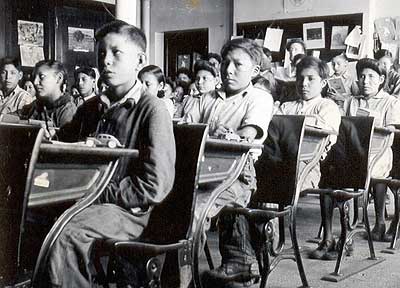 |
| The above is a photo of Old Sun Indian Residential School (Gleichen, AB). (Canada in the Making, 2008). |
 |
| The above is an example of aboriginal children from the Cree tribe learning a whole new set of behaviours. (Indigenous Institute of the Americas, 2006). |
 |
| The above depicts Cree children learning to pray. (Indigenous Institute of the Americas, 2006). |
 |
| Children were even taught to give themselves more European hairstyles. (Remembering the Children, 2009) |
References
Canada in the Making. (2008). Aboriginal residential schools. Retrieved January 30, 2011,
from http://www2.canadiana.ca/citm/specifique/ababresschools_e.pdf
Remembering The Children. (2009). Historical sketch of anglican residential schools.
Retrieved January 30, 2011, from
http://www.rememberingthechildren.ca/history/history-acc.htm
http://www.rememberingthechildren.ca/history/history-acc.htm
Vawnet. (2003). Cultural humility. Retrieved January 30, 2011, from
http://new.vawnet.org/category/index_pages.php?category_id=922
Indigenous Institute of the Americas. (2006). Anglican residential schools in canada in 1955.
Retrieved January 30, 2011, from
http://www.indigenousinstituteamericas.org/ourdailyfrybread.html

No comments:
Post a Comment