Sunday, January 30, 2011

Equity and Equality. Cultural Competence and Cultural Issues

       In class we have talked about  understanding the concepts of culture, cultural competence, and cultural humility. Cultural competence is an ability to interact effectively with people of different cultures. Some research states that it is an awareness of one's own cultural worldview, attitude towards cultural differences, knowledge of different cultural practices and worldviews, and cross-cultural skills. I think that by developing cultural competence people are better able to understand, communicate with, and effectively interact with people across cultures.


     In particular, in class we have talked about some examples of how historically people have lacked cultural competence, and how that has adversely affected people, nations, and cultures alike. Like the historical event of colonization in Canada, which I will discuss in greater detail later.


      It is important to studying history, because WE ARE the past! By looking back and learning from previous mistakes, and successes, we can plan for a better future. We talked about the purpose of residential schools (for aboriginals). We spoke about how this was a mistake. Essentially, at the start of the 1830s, in Canadian society, the government supported the Catholic Church, and other churches (such as Methodist, Presbyterian and Anglican) in doing mission work amongst the natives strting in New France (New Brunswick), this later spread to the Prairies in the 1870s. Schools were set up, and run by the church. In retrospect, these schools came at a serious price, (they are the cause of many social problems within Aboriginal communities today). The church, with support from the government took the kids out of their communities and were brought into cities/colonies. The natives were made to speak english and were assimilated into the new culture in which they were being forced to live. The thought was that the aboriginal children living and learning in these schools with no contact from their family/previous culture would cause them to walk out being "Canadian". This was no proud moment/these were no proud decades for our Canadian culture.    


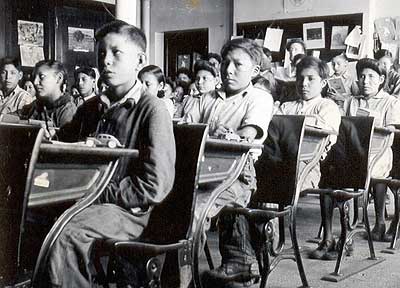
Below are some photos of residential schools throughout Canada, and throughout our history.


The above is a photo of Old Sun Indian Residential School (Gleichen, AB).
(Canada in the Making, 2008).


The above is an example of aboriginal children from the Cree
tribe learning a whole new set of behaviours.
(Indigenous Institute of the Americas, 2006).


The above depicts Cree children learning
to pray. (Indigenous Institute of the Americas, 2006).
         It was wrong to take children out of their homes and their cultures, and there was also sexual and verbal abuse that went on within these organizations. This is a prime example of our predecessors ability to interact effectively with people of different cultures. Canadians were not open about cultural differences, and didn't develop a knowledge, or understanding of different cultural practices. Canadians didn't try to understand, communicate with, and effectively interact with the aboriginal people, they merely forced them to change. As stated above, for a century later, we are still suffering the repercussions of this mistake to varying degrees. Cultural Humility is an ongoing process of self awareness and reflection to recognize, understand, and respect different beliefs, values, and practices. Canadians were not open and/or flexible to accept the cultural differences, learn about another culture and to build relationships on similarities. Had they been open to doing so, much conflict, upset and injustice would have been averted.


Children were even taught to give themselves more European hairstyles. (Remembering the Children, 2009)


References


Canada in the Making. (2008). Aboriginal residential schools. Retrieved January 30, 2011, 

      from http://www2.canadiana.ca/citm/specifique/ababresschools_e.pdf


Remembering The Children. (2009). Historical sketch of anglican residential schools. 

     Retrieved January 30, 2011, from 


     http://www.rememberingthechildren.ca/history/history-acc.htm


Vawnet. (2003). Cultural humility. Retrieved January 30, 2011, from 

     http://new.vawnet.org/category/index_pages.php?category_id=922
  

Indigenous Institute of the Americas. (2006). Anglican residential schools in canada in 1955.

      Retrieved January 30, 2011, from 

     http://www.indigenousinstituteamericas.org/ourdailyfrybread.html

Friday, January 28, 2011

Power

Week Four-Power:

      The below news reels give a background and snapshot of the current goings on in Egypt, where there are  protests and anti-government demonstrations with regards to political suppression, corruption and unemployment.


           This week I have decided to focus on power after a conversation with one of my close friends who currently attends Western, but is originally from Dubai. I had heard about the protesting that has been going on over the past few days, but my friend was able to give me more details and further insight about the current situation, as much of her family is currently living in Egypt.

          This week's reading defined power as the capacity of some persons to produce intended and foreseen effects on others. The reading also defined many different types of power, which I think can be applied to this current global issue. For instance a person can be powerless-lack authority, or the capacity to act, or a person can be empowered-have developed confidence in his or her own capacities. The people of Egypt felt powerless, and started to band together, initially through a simple networking tool-Facebook.

         The Facebook group that triggered people to act/ protest was started by one individual and this can be likened to our week four class where a video clip was shown of one person dancing on a hill. Another person eventually joined that single person. A follower who in turn became a leader for the subsequent follower and so on joined the original leader. As soon as about four of five people were dancing, a mass of many others joined. This instance is similar to how the current population of Egypt started their protests. The Egyptians seem to have found their "personal power"/the power from within to act out against a "power-over" situation that they feel to be unfair..... One person started the Facebook group and their friends joined it, then the friends of those friends joined, and so on, this became a "power-with" situation. The group began to gain more power and more confidence as more and more people joined.

           
       For many years, the government has ruled using "expert power" to some degree. The governing body had superior power over the nation, which caused political suppression, corruption and unemployment. "Coercive power" was shown by the government when, in an effort to stop the protests, and the "power of the people", the authorities announced a curfew from 1800 to 0700 local time. At many locations, riot police even fired rubber bullets, water cannons and tear gas. Internet and phone services both mobile and landline-have also been disrupted over the past few days. This disruption of communication is an example of "information power", as information that would normally be received through these methods of communication is being withheld. The government is using authority or power that is dependent on fear, suppression of free will, and/or use of punishment or threat, for its existence, which is exactly what our class text claims "coercive power" is. The Egyptian government no longer has "legitimate/elected power" and has started to use "coercive power" because all else has failed.


      In class, we spoke about: empowerment, equity, social justice, participation, collaboration, bottom up strategies. We spoke about how choice is THE simplest form of power. The people of Egypt made the choice to change the way their country operates, and to speak out against the injustices they have faced.
They found their Power from Within:
-psychological power
-self knowledge
-perceived control over personal life
......and spoke out against the government (Power-over): One made to do what other wishes…..dominance (forces), like resources, barriers to decision making/agenda setting, information control.
Government officials spraying citizens with water cannons.
(Greenwich Time, 2011). 


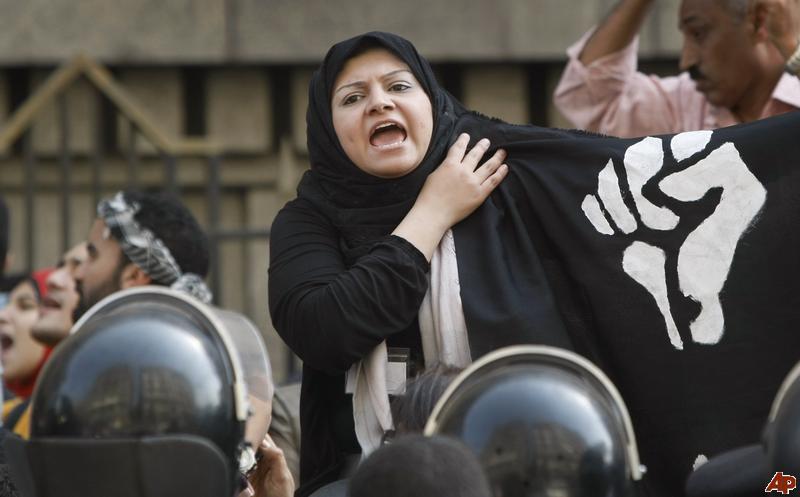
Egyptian security forces hit protesters and knocked some to the ground before rounding up dozens at a demonstration on Sunday against a police beating that killed a man about a week ago. (Sassywire, 2010).


......Now on March 12th, 2011 looking back on this issue, I have found a great link that documents the goings on of January 25th, 2011 in Egypt, it is shown below:


References


Youtube. (2011). Egypt: january 25th, 2011. [Video file]. Retrieved March 10, 2011, from 


         http://www.youtube.com/watch?v=ThvBJMzmSZI&feature=player_embedded


Youtube. (2011). Egypt protests inspired by tunisia riots. [Video file]. Retrieved January 27, 2011, 

         from http://www.youtube.com/watch?v=SrQ0fHI_JFY&feature=player_embedded


Youtube. (2011). Egypt's violent day of anger. [Video file]. Retrieved January 27, 2011, from 

         http://www.youtube.com/watch?v=pgh1iOXI6sQ&feature=player_embedded

Guardian.co.uk. (2011). Egypt braced for 'day of revolution' protests. Retrieved January 24, 2011, 

        from http://www.guardian.co.uk/world/2011/jan/24/egypt-day-revolution-protests


Greewich. com (2011). Antigovernment protests in egypt. Retrieved January 24, 2011, from 


        http://www.greenwichtime.com/news/slideshow/Anti-government-protests-in-Egypt-2677.php


Sassy Wire. (2010). Retrieved January 30, 2011, from http://sassywire.wordpress.com/2010/06/


Monday, January 24, 2011

Health Promotion Personal Reflection

An Overview of What Health Promotion is to Me:

In class we have discussed how "health promotion" is an umbrella term and can mean many different things to many different people. People in class thought of "health promotion" as:

-empowerment
 -equity/social justice
 -access
 -partnership
 -an umbrella term
 -health education
 -a marketing tool
 -a type of lifestyle modification/a social or environmental change
 -a values based approach
Health Promotion:

o    Empowerment
o    Equity/social justice
o    Access
o    Partnerships
§  Partnering with and partnering different sectors
§  Work with community/partner
                                        §  Identify goals, and work out process of achieving those goals in a partnership                              relationship        


        The World Health Organization defines health as "The process of enabling people to increase control over, and to improve, their health. It moves beyond a focus on individual behaviour towards a wide range of social and environmental interventions". I found it hard to think of what exactly health promotion was to me and I feel that it can't really be defined as it is very different, depending on the person you talk to and their own specific situation. So the point of this blog is to use what has been discussed in class and in the readings as well as my own personal research to find a definition of health promotion that I think fits.

       In class, we talked about how approaches to health promotion can be: behavioural, relational/contextual, or structural/socio political (situations of poor health vs. better health). But what does this mean to me?

        To me, behaviour refers to actions, these actions could be in relation to environment, other organisms, and other systems. So this means that health promotion can centrally focus on changing or improving the actions of the community, person, family/whoever is the central focus of the project. Health Promotion with regard to context refers to the class, gender or race being dealt with. It could even be described as the social identity of the people being dealt with. Through reading, and my own person thoughts, I have come to the conclusion that to me, health promotion with regard to structure, is the patterns and relationships of the entities being dealt with. I think that Health Promotion is the process of enabling people to increase control over, and to improve, their own personal health. It is a process of empowerment. Health Promotion can and should move beyond a focus on individual behaviour towards a range of varying social and environmental interventions. When starting a Health Promotion initiative, I believe it to be important to look at whether the benefits will outweigh the costs. Through research, I have also come upon another framework which I believe to be very helpful in understanding the basic framework of a Health Promotion project. It can be defined/expressed using the "SMART Objectives System". It states that a Health Promotion project needs to be S-specific, M-measurable, A-achievable, R-realistic, and needs to have the T-time it will take stated. This means that in order to be successful at developing and initiating a Health Promotion initiative, one must have a plan in place, a time limit, and needs to be realistic about what exactly they hope to achieve.


        Health Promotion can take on many forms and I believe the form it takes on is entirely dependant on the person/group with which you are working the location and situation of the person/group. It also is determined be the desired end goal. My thoughts correlate nicely with the WHO's view, so I know that I am on the right track. WHO says that "strategies are not limited to a specific health problem, nor to a specific set of behaviours. Health Promotion is directed to a variety of population groups, risk factors, diseases, and in various settings and is associated efforts put into education, community development, policy, legislation and regulation, are equally valid for prevention of communicable diseases, injury and violence, and mental problems, as they are for prevention of noncommunicable diseases".

         Through my research and personal reflection, I have come to the conclusion that Health Promotion is very difficult to define as it is an umbrella term which covers a broad spectrum of potential definitions. Conversely it could be thought of as easy to define, because it has so many definitions. I have found that a few things can be said, however that seem to be the common grounding and framework for all ideas/definitions of Health Promotion Health Promotion. It is always work that focusses on developing a positive outcome/an improvement in a person/population. Health Promotion should have prerequisites of health such as income, housing, food security, employment, or quality working conditions. Health Promotion needs a common, realistic and achievable goal which should be worked towards in an efficient manner.

     The following links are a pair, and they both give some background on one view of Health Promotion, its role in a globalized world, and the history of how Health Promotion has developed. The video has definitely influenced and solidified my view of Health Promotion. This overview speaks about some major World Health Organisation documents and 3 theoretical models of health promotion. Presenation is in 2 parts.


References


Googlebooks. (2011). Health promotion: effectiveness efficiency, equity. Retrieved January 24, 2011, 

        from http://books.google.com


World Health Organization. (2011). Health promotion. Retrieved January 24, 2011, from                                     


       http://www.who.int/healthpromotion/en/index.html


Youtube. (2011). Health promotion part I [video clip]. Retrieved January 24, 2011, from  


       http://www.youtube.com/watch?v=mEVQ2mqZLP0&feature=player_embedded

Youtube, (2011). Health promotion part II. (2011). Retrieved January 24, 2011, from 

       http://www.youtube.com/watch?v=jcK1ZaWaEOY&feature=player_embedded