 |
| Otto Von Bismark (Knowledge Rush, 2009). |
We have spoken quite a bit in class about Health Care and Global Health in general, but have not delved deeply into the topic of how Universal Health Care came about in Canada. I would like to know how Universal Health Care came about, which is why the below post will be dedicated to my own personal findings on how and when Health Care came about in Canada.
First off, what is Universal Health Care exactly?
Universal Health Care is a health insurance program in many countries (not including the U.S.A) that is financed by taxes and administered by the government to provide comprehensive health care that is accessible to all citizens of that nation. The term Universal Health Care refers to an organized health-care system that is built around the principle of universal coverage for all members of that particular society. It combines mechanisms for health financing and service provision.
What is the History of Universal Health Care?
Many think of Germany and Otto von Bismarck's social legislation as having the world's oldest Universal Health Care System. Otto, a German-Prussian statesman/a central figure in world affairs lived from April 1st, 1815 – July 30, 1898. He brought about the first welfare state in the 1880s. Otto also implemented bills such as Health Insurance Bill in1883, Accident Insurance Bill in 1884, and Old Age and Disability Insurance Bill in 1889.
In Britain, the National Insurance Act of 1911 symbolized the first movement towards Universal Health Care. The act is seen as one of the foundations of modern social welfare in the United Kingdom.
Most current Universal Health Care systems were put in place following World War Two to reform Health Care (as we have touched on in class). The idea was to make health care available and accessible to all citizens. In 1948, Article 25 of the Universal Declaration of Human Rights was signed by many countries, however, the U.S.A did not approve of the social and economic rights sections, including Article 25's right to health.
Article 25 of the Universal Declaration of Human Rights states:
(1) Everyone has the right to a standard of living adequate for the health and well-being of himself and of his family, including food, clothing, housing and medical care and necessary social services, and the right to security in the event of unemployment, sickness, disability, widowhood, old age or other lack of livelihood in circumstances beyond his control.
(2) Motherhood and childhood are entitled to special care and assistance. All children, whether born in or out of wedlock, shall enjoy the same social protection.
What are some Implementation Comparisons between Canada and other Countries who have Universal Health Care?
The government is more heavily involved in some Health Care systems than in others, in the UK, Spain, Italy and the Northern European countries, the government has a high degree of involvement in the delivery of health care services. Access to these systems is based on residence rights not on the purchase of insurance. Other countries have contributory insurance rates related to salaries or income, and are usually funded by employers and beneficiaries jointly. Sometimes the health funds are from a mixture of insurance premiums, salary related mandatory contributions by employees and by government taxes. These insurance based systems tend to reimburse private or public medical providers, often at heavily regulated rates.
Universal Health Care can be implemented in different ways, because it is a broad concept. What remains the same, however, is the fact that the government is trying to extend access to Health Care through legislation/regulation and taxation. Regulation means to direct what care/to whom it must be provided. Governments also maintain this by setting minimum standards. Some programs are paid for entirely out of tax revenues. In others, tax revenues are used either to fund insurance for the very poor or for those needing long term chronic care.
The History of the Canadian Universal Health Care System:
Thomas Clement Douglas, has been known to many as the father of Health Care/Medicare in Canada. He was born on October 20, 1904 and died February 24, 1986.
Tommy started out as a Scottish Baptist minister, but became leader of the CCF (Saskatchewan Co-operative Commonwealth Federation) in 1942. He went on to become the 7th Premiere of Saskatchewan, and became the first federal leader of the NDP (New Democratic Party from 1961-1971).
References
Cox and Forkum (2007). The benefits of universal healthcare. Retrieved March 21, 2011, from
coxandforkum.com
Jesustians (2005). Tommy douglas. Retrieved March 21, 2011, from
http://www.jesustians.com/main.htm
United Nations (2011). The universal declaration of human rights. Retrieved March 20, 2011, from
http://www.un.org/en/documents/udhr/index.shtml
Many think of Germany and Otto von Bismarck's social legislation as having the world's oldest Universal Health Care System. Otto, a German-Prussian statesman/a central figure in world affairs lived from April 1st, 1815 – July 30, 1898. He brought about the first welfare state in the 1880s. Otto also implemented bills such as Health Insurance Bill in1883, Accident Insurance Bill in 1884, and Old Age and Disability Insurance Bill in 1889.
 |
| Universal Health Care comic displaying the benefits of Universal Health Care (Cox and Forkum, 2007) |
In Britain, the National Insurance Act of 1911 symbolized the first movement towards Universal Health Care. The act is seen as one of the foundations of modern social welfare in the United Kingdom.
Most current Universal Health Care systems were put in place following World War Two to reform Health Care (as we have touched on in class). The idea was to make health care available and accessible to all citizens. In 1948, Article 25 of the Universal Declaration of Human Rights was signed by many countries, however, the U.S.A did not approve of the social and economic rights sections, including Article 25's right to health.
 |
| The Universal Declaration of Human Rights Document, held by Eleanor Roosevelt, who considered it to be her greatest accomplishment (Franklin and Eleanor Roosevelt Institute, 1998) |
Article 25 of the Universal Declaration of Human Rights states:
(1) Everyone has the right to a standard of living adequate for the health and well-being of himself and of his family, including food, clothing, housing and medical care and necessary social services, and the right to security in the event of unemployment, sickness, disability, widowhood, old age or other lack of livelihood in circumstances beyond his control.
(2) Motherhood and childhood are entitled to special care and assistance. All children, whether born in or out of wedlock, shall enjoy the same social protection.
What are some Implementation Comparisons between Canada and other Countries who have Universal Health Care?
The government is more heavily involved in some Health Care systems than in others, in the UK, Spain, Italy and the Northern European countries, the government has a high degree of involvement in the delivery of health care services. Access to these systems is based on residence rights not on the purchase of insurance. Other countries have contributory insurance rates related to salaries or income, and are usually funded by employers and beneficiaries jointly. Sometimes the health funds are from a mixture of insurance premiums, salary related mandatory contributions by employees and by government taxes. These insurance based systems tend to reimburse private or public medical providers, often at heavily regulated rates.
Universal Health Care can be implemented in different ways, because it is a broad concept. What remains the same, however, is the fact that the government is trying to extend access to Health Care through legislation/regulation and taxation. Regulation means to direct what care/to whom it must be provided. Governments also maintain this by setting minimum standards. Some programs are paid for entirely out of tax revenues. In others, tax revenues are used either to fund insurance for the very poor or for those needing long term chronic care.
 |
| The above figure is a depiction of all the countries who have Universal Health Care (Shown in blue), Countries attempting to implement Universal Health Care (shown in green), Countries with no Universal Health Care system (shown in grey) and Countries where coverage is provided by the U.S.A through war funding (shown in orange-Iraq and Afghanistan). (AOL. Gadling, 2011). |
The History of the Canadian Universal Health Care System:
 |
| Tommy Douglas, the father of Health Care in Canada. (Jesustians, 2005) |
Tommy started out as a Scottish Baptist minister, but became leader of the CCF (Saskatchewan Co-operative Commonwealth Federation) in 1942. He went on to become the 7th Premiere of Saskatchewan, and became the first federal leader of the NDP (New Democratic Party from 1961-1971).
In about 1946 Saskatchewan introduced what would become universal coverage. The province had suffered a shortage of doctors, and many towns were having to subsidize a Doctor to practise there. This lead to something called The Municipal Doctor Program. Union Hospitals were then opened which had similar costs as far as subsidizing. In 1946, Tommy, who at the time was part of the CCF government in Saskatchewan passed the Saskatchewan Hospitalization Act. This act guaranteed free hospital care for much of the population. At the time, it had been Tommy Douglas' hope to provide Universal Health Care, but the province didn't have have the money. The implementation of this act, however, was the boost that Canada needed in terms of Health Care and set the Country up for future success with regard to achieving Universal Health Care!
In 1950, Alberta created a program similar to Saskatchewan's in 1948 to provide prepaid health services with provided Health Care to 90% of the population. Following these models, In 1957, John Diefenbaker (Canada's 13th Prime Minister) passed the Hospital Insurance and Diagnostic Services Act which funded 50% of the cost of programs within the Provinces. The HIDS (Hospital Insurance and Diagnostic Services) Act outlined five conditions:
1. public administration
2. comprehensiveness
3. universality
4. portability
5. accessibility
...........These remain the pillars of the Canada Health Act.
In 1950, Alberta created a program similar to Saskatchewan's in 1948 to provide prepaid health services with provided Health Care to 90% of the population. Following these models, In 1957, John Diefenbaker (Canada's 13th Prime Minister) passed the Hospital Insurance and Diagnostic Services Act which funded 50% of the cost of programs within the Provinces. The HIDS (Hospital Insurance and Diagnostic Services) Act outlined five conditions:
1. public administration
2. comprehensiveness
3. universality
4. portability
5. accessibility
...........These remain the pillars of the Canada Health Act.
By 1961, all ten provinces had agreed to start HIDS Act programs. In Saskatchewan, the act meant that half of their current program would now be paid for by the federal government. It was decided that this freed money should be used to extend the Province's health coverage to include physicians........ It is because of this that Tommy Douglas is widely known as the creator of Medicare and the father of Health Care in Canada.
In 1964, Justice Hall recommended the nationwide adoption of Saskatchewan's model of Public Health Insurance and in 1966, the Liberal minority government of Lester B. Pearson (Canada's 14th Prime Minister) created the program. The federal government payed 50% of the costs for Health Care, and the provinces were responsible for paying the other half. So all in all, our health Care system can be attributed to Tommy Douglas, John Diefenbaker and Lester B. Pearson!
In 1964, Justice Hall recommended the nationwide adoption of Saskatchewan's model of Public Health Insurance and in 1966, the Liberal minority government of Lester B. Pearson (Canada's 14th Prime Minister) created the program. The federal government payed 50% of the costs for Health Care, and the provinces were responsible for paying the other half. So all in all, our health Care system can be attributed to Tommy Douglas, John Diefenbaker and Lester B. Pearson!
 |
| Tommy Douglas, Leader of the NDP Party until 1971 (Canadian Museum of Civilization, 2010) |
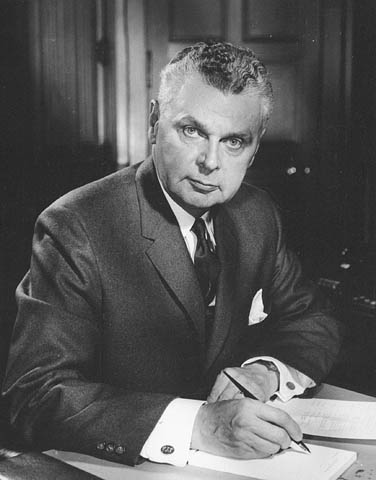 |
| John Diefenbaker, Canada's 13 Prime Minister (Library and Archives Canada, 2002) |
 |
| Lester Pearson, 14th Prime Minister of Canada (Britannica Academic Edition, 2011) |
References
Aol, Gadling (2011). What countries have universal health care. Retrieved March 22, 2011, from
http://www.gadling.com/2007/07/05/what-countries-have-universal-health-care/
Canadian Museum of Civilization (2010). Tommy douglas. Retrieved March 24, 2011, from
http://www.civilization.ca/cmc/exhibitions/hist/biography/biographi273e.shtml
Cox and Forkum (2007). The benefits of universal healthcare. Retrieved March 21, 2011, from
coxandforkum.com
Franklin and Eleanor Roosevelt Institute (1998). Eleanor Roosevelt. Retrieved March 21, 2011, from
http://www.udhr.org/history/biographies/bioer.htm
ITA Geographic (2004). Otto von bismarck. Retrieved March 20, 2011, from
http://www.photius.com/countries/germany/society/germany_society_development_of_the_
Jesustians (2005). Tommy douglas. Retrieved March 21, 2011, from
http://www.jesustians.com/main.htm
Knowledgerush (2009). Otta von Bismark. Retrieved March 1, 2011, from
http://www.knowledgerush.com/kr/encyclopedia/Otto_von_Bismark/
Library and Archives Canada (2002). John diefenbaker. Retrieved March 24, 2011, from
http://www.collectionscanada.gc.ca/2/4/h4-3325-e.html
The Free Dictionary By Farlex (2011). Universal Health Care. Retrieved March 1, 2011, from
http://medical-dictionary.thefreedictionary.com/Universal+health+care
United Nations (2011). The universal declaration of human rights. Retrieved March 20, 2011, from
http://www.un.org/en/documents/udhr/index.shtml


