Monday, February 28, 2011

Senator Segal and Poverty

     In class, we have talked about why we need to define poverty, because we can't solve a problem that can’t be defined! We also spoke about the triangle within international health: poverty is linked to ill-health, and also to inequity (lack of fairness and justice).


    Many factors combine together to affect the health of individuals and communities. Socio-ecological perspective is the idea that our health is shaped within the context in which we live. It is the unique idea of chance, and choice, (we have different opportunities depending on the context in which we live). Determinants of health give us a framework to see if we have attended to issues, and established what can impact an individual’s and community’s health.


The Determinants of Health include:


the social and economic environment,


the physical environment, and


the person’s individual characteristics and behaviours.


The Determinants of Health (Inclusion and Health, 2006).


     We spoke about how the context of people’s lives determines their health, and so blaming individuals for having poor health or praising them for good health is inappropriate. Individuals are unlikely to be able to directly control many of the determinants of health. These determinants—or things that make people healthy or not—include the above factors, and many others (according the the World Health Organization-see references below):


Income and social status - higher income and social status are linked to better health. The greater the gap between the richest and poorest people, the greater the differences in health.


Education – low education levels are linked with poor health, more stress and lower self-confidence.


Physical environment – safe water and clean air, healthy workplaces, safe houses, communities and roads all contribute to good health. Employment and working conditions – people in employment are healthier, particularly those who have more control over their working conditions


Social support networks – greater support from families, friends and communities is linked to better health. Culture - customs and traditions, and the beliefs of the family and community all affect health.


Genetics - inheritance plays a part in determining lifespan, healthiness and the likelihood of developing certain illnesses. Personal behaviour and coping skills – balanced eating, keeping active, smoking, drinking, and how we deal with life’s stresses and challenges all affect health.


Health services - access and use of services that prevent and treat disease influences health


Gender - Men and women suffer from different types of diseases at different ages.


      The above points link to our class discussions about how poverty historically has established that health and money equalize each other. Health can be dependant on the sophistication of communities.We have also spoken about how there has been an increasing need for the development of the social safety net which is the idea of preventing the poor or those vulnerable to poverty from falling below a certain poverty level. Safety net programs can be provided by the public sector (the state and aid donors) or the private sector (NGOs, private firms, charities, and informal household transfers).


Types of Safety Net Transfers include:


-Cash transfers


-Food-based programs such as supplementary feeding programs and food stamps, vouchers, and coupons


-In-kind transfers (like school supplies and uniforms)


-Conditional cash transfers


-Price subsidies for food, electricity, or public transport


-Public works


     Class discussions also eluded to the fact that Senator Segal (a Conservative) is also keeping poverty on the national agenda. Poverty is not about measuring up to a standard or having enough money to get by with the basics. Canada has 5-8 million Canadians on welfare. These people don’t receive as much as what Stats Can defines to be what they actually need to get basic housing, clothing, heat, and food. This is why places like Calgary are so wealthy in some locations and not in others (like the central downtown area).
Senator Hugh Segal, (The Senate of Canada, 2010)


     Inequality is something that is always going to exist. Realistically, poverty can’t be eradicated, but many places like Germany and France are dealing with it in a much better way. Our class has opened my eyes to the fact that although poverty seems to be well disguised in London and many are unaware of it, it is truly a big problem. We need to fix the fact that we have a "one-sze fits all" welfare system and re-think our “microfocussed/micromanaged welfare” as discussed in class.


      Many of our welfare systems are actually traps it seems, and we have some problems that must be fixed within our system. Some people are gaming the system, but one must look at all the people who game the system in a bigger way like in the United States last September with the bank collapse! 


      Many people have actually been gamed by the system which is why they have fallen below the poverty line in the first place. We discussed in class that poverty can be classified in many cases as having to negotiate and allocate other resource to be able to have enough money to provide food for the family experiencing hardship. 48% of those who fall between the poverty lines are actually working in many provinces. Some people just need to be "topped up" for a certain period of time.


      150 billion dollars between provinces not including health and education is sent out to help people per year. The ability of the system to top people up is quite easy. If a person earns a certain amount or below a certain amount as a senior, they are automatically 'topped up'. Poverty is bad for business as it decreases the amount of people who can consume, and decreases the amount of educated people who can work and get jobs and puts a bigger strain on those who are earning.


       We have looked at reasons why poor people remain poor, and some are listed above with the WHO's determinants of health, other reasons are that, poor people, don’t go to meetings, don’t vote, and don't participate in community functions/don't interact with the community as a citizen because they are too busy worrying about food, money, how they are going to pay for things, so their voice is heavily diluted. Some don’t have the skill set/know how to advocate for their rights. The rest of us don’t come up against obvious poverty in our daily lives, so it isn’t at the forefront of our minds. Poverty tends to be unseen. We need to not change the behaviours, but we need to change the context in which they sit. Context matters!!!! Senator Segal states that there should be equality of opportunities, not outcomes. So, people need to have the same chance and that is why some changes need to be made!


References


Braverman, L. E., & Utiger, R. (2005). Werner and Ingbar's The Thyroid: A Fundamental and Clinical 

     Text (9th ed.). Philadelphia: Lippincott Williams & Wilkins.


Child and Youth Network (2011). London’s food charter. Retrieved February 18, 2011, from 

      http://london.childyouthnetwork/


Chinn, P.L. & Kramer, M.K. (2004). Nursing’s fundamental patterns of knowing. In Integrated 

      knowledge development in nursing (6th ed., pp.1-17). St. Louis, MO: Mosby.


Count Me In Forum (2006). The determinants of health. Retrieved February 28, 2011, from 

      http://www.count-me-in.ca/forums/slides/inclusion2.html


Kaiser, M (2011). Food security and community. Routledge Taylor and Francis Group.


Siefert, K., Hein, C. M., Corcoran, M. E., & Williams, D. R. (2001). Food insufficiency and the physical

      and mental health of low-income women. Women Health, 159–177.

The Senate of Canada (2010). Hugh Segal. Retrieved Feubruary 28, 2011, from 

     http://www.hughsegal.ca/

World Health Organization (2011). The determinants of health. Retrieved February 17, 2011, from 

     http://www.who.int/hia/evidence/doh/en/


Sunday, February 27, 2011

The March

       Instead of doing lots of reading research this week, I decided to watch a film that would tie into our classes, and into the concept of Global Health. The film I chose was called The March. The movie was not a true story, but very well could have been. It was about relief camps set up in Africa filled with people who were forced to leave their land (due to global warming). This situation unto itself, poses one question: are the developed nations the root cause of problems in developing world nations? (We are the ones who have created most of the pollution to cause  Global Warming, so have we, in fact, ruined the livelihood of those who were once farmers? ). The March was created about 10 years before 9/11 (September 11th, 2001). The film gave a broad understanding/example of a  situation that can create problems in global health. It posed challenging questions like: "What sort of world are we creating?" and, when it comes to Third World countries, are we looking for a band-aid or a long-term solution?

      In the movie, the refugee camps were not receiving enough aid and people were starving. The world was sending some aid, but not enough was being delivered to the people (the corrupt government was keeping much of the money and much of the aid was ending up in black markets). The people in the camps were becoming increasingly more frustrated and decided to march all the way to Spain (across North Africa), to show Europe, and the people of the world,  that they existed, their problems were real, and they needed help. The hope was that by putting faces to the problem, the systemic causes of the problem would be solved. The movie ends with the people arriving on the shores of Spain, to be met by a huge number of military personnel, and no resolution to their conflict.

        The moral of the story, essentially, is that, all these people wanted was food, shelter, clothing and healthcare. They wanted those things in place, and then as discussed in class, they wanted education so that they could then become self- sustaining and self -sufficient. Education would allow people to provide their own food, shelter, clothing and healthcare. This story didn't actually happen, although, it very well could have; and 10 years after this movie was created,  9/11 happened. There is more than one interpretation for the occurrence of 9/11. Some think that the people of the Middle East like in the movie The March, were demanding these basic elements of survival, and when nothing was done, they struck back in a violent way to make a point. Some see 9/11 as an act of terror, while others believe that it may have been a cry for help.

Some see 9/11 as an act of terror, while others think
it in a way way a cry for help. (Conspiracy Planet,  2011).


       The bigger questions seem to exist about whether food, shelter, clothing, healthcare and education are rights or  privileges. If they are civil rights (rights individuals have according to nationality), then that is an issue involving the nation within which a person lives (Africa in this example). If, however, these things are human rights, it doesn't matter the citizenship of the people in question; it is the right of all humans.

     The story doesn't really end, because the story and issue that the movie The March was addressing continues in our world today. It was apparent during 9/11 and now is apparent in the Middle East. The foundation of the unrest remains the same. People are wanting to have more power over their lives. They want to be able to provide for themselves, and want their government to serve them, rather than the government being corrupt and serving themselves.

       In the past, people of developing nations have rallied around religion, but now, the middle class is growing and people are demanding basic rights; they don't want dictators. The people want democracy, and they want it to be a civil right that is enshrined in their nation's constitution. Essentially, for there to be change, wealthy countries need to move beyond 19th and 20th century thinking of "Nation States" (a country having authority over another area). We need to create a true Global Village (bringing social and political function together). This can be tied even more into Global Health in the sense that it's not enough to go into a nation and do charity, or mission work. Justice needs to be put in place, and the underlying problems need to be fixed. The alternative is to be left with a divided nation (the creators of Global Warming vs. receivers of Global Warming, developed nations vs. developing nations, northern hemisphere vs. southern hemisphere, rich vs. poor, secular societies vs. practising muslims, former slave owners vs. former slaves, former empires vs former colonies). Some think that the threat of the 20th century was that of nuclear war, and now it is believed that the threat of a third world war with respect to the developing nations fighting the developed nations.


.......Looking back on this post today (on March 13, 2011), it is even more clear that this really is a current issue. Examples of people rebelling and wanting more from their nations and leaders are coming up throughout the middle east and are surfacing in the news. Tunisia rebelled, then Egypt, Libya, and now there is unrest in other surrounding areas as well. People are wanting change,  and in this day and age, with technology and other advances, people are rallying and speaking out!


References

Conspiracy Planet. (2011). Crime of the century: the israeli mossad and 9/11. Retrieved February 27, 


      2011, from http://www.conspiracyplanet.com/channel.cfm?ChannelID=89


September 11 Webarchive. (2001). September 11 archive. Retrieved February 27, 2011, from 


      http://september11.archive.org/


Wednesday, February 23, 2011

Poverty

       This class has been all about building on our understanding of health from a socio-ecological perspective. We have focused on poverty as an influential factor in the determination of health. We've also been exploring the concept of ‘poverty’ and how it can be defined and measured. We talked about the triangle within international health: Poverty is linked to ill-health, and also to inequity (lack of fairness-many people who are poor are not that way by choice)-this idea can be linked to the question about whether or not people choose to have disease-based on lifestyle and/or live in poverty. Poverty is multi-dimensional, and changes depending on the context and perspective at which it is viewed.


       Socio-ecological perspective is the idea that our health is shaped within the context in which we live. We discussed how the idea of chance, and choice, is an important factor, when it comes to poverty. We have different opportunities depending on the context in which we live and can't help the kind of situation we are born into, but we can make a choice to change that situation.


     The determinants of health give us a framework to see if we have attended to issues. They also establish what can impact an individual’s and community’s health. Historically, it has been established that health and money equalize each other in a sense. Health is also dependant on the sophistication of communities.


      There has been an increasing need for development of the "social safety net"-the prevention of people falling below the poverty line. For instance, in the 1940s-the end of WW2- this was done through the development of public health methods-immunizations, pasteurization of milk, waste disposal. In 1966, Health Insurance/universal coverage was started, and then physicians came on board. Events like these help to keep the population healthy, productive, organized, and above the poverty line. This net is continuing to grow and change as our society continues to grow and change.


        As far as poverty within North America, some people are gaming the system, but many of those who are impoverished have been gamed by the system which is why they have fallen below the poverty line in the first place. 150 billion dollars between the Canadian provinces, not including health and education is sent out to help people each year. Is that money always getting to the people who need it or is it being wallowed up my corrupt governments like those in the Middle East? 


       Poverty is bad for business as it decreases the amount of people who can consume, and decreases the amount of educated people who can work and get jobs. This then puts a bigger strain on those who are earning. Being poor tends to be a vicious circle, as poor people, tend not to go to meetings, don’t vote, and aren't a strong voice in our society because they are too busy worrying about food, and money, these worries/other obligations mean that their voice is heavily diluted within their community. Some don’t have the skill set/the know how to advocate for their rights (this could be a product of the way they were brought up, or the situation they were born into). 


     The rest of us don’t come up against obvious poverty in our daily lives, so it isn’t at the forefront of people’s minds. Poverty in many ways tends to be unseen, as we discussed in class. Many students who attend Western live in the "Western Bubble" and are oblivious to the fact that London has people who are homeless and live below the poverty line.


       The "social safety net" allows us to start to see the differences between those who are disadvantaged, and those who are not. Throughout my own research this week, I have tried to understand the strategies / methods that can be put in place to alleviate poverty. I will also be looking at the use of microfinancing and its contribution to debt alleviation. I'll look at the benefits and disadvantages of ‘AID’ strategies and explore the controversy that surrounds aid initiatives. All of the above questions will be tied into some bigger concepts which I have researched, like the fact that during the 20th century many thought that the threat of a Third World War was an issue in the sense of a fear of having a nuclear war. Now in the 21st century, the threat seems to be about a Third World War (involving the developing countries). I also want to know why it is that poor countries seem to continue to stay poor?


       The United Nations considers microfinance to be an important tool for achieving the goals of reducing poverty. Micro-financing is when financial services are provided to low-income citizens or solidarity lending groups (small groups which borrow collectively). Solidarity lending groups can include consumers and the self-employed, (generally those who lack access to banking and related services). Micro-financing enhances a micro-entrepreneur's capacity and also generates employment opportunities, among other things. It allows for small companies to receive loans without collateral (a pledge of certain belongings to secure a loan-in the even that interest or principle is not paid, the recipient of the loan forfeits the pledged belongings). As far as debt alleviation, some research states that even the most established microlending programs have yet to prove that microlending is more successful than welfare-style programs in lifting people permanently out of poverty. As we have touched on in class, like any other development strategies, microlending for the purpose of developing small businesses is a complicated task. It that requires an understanding of the particular economic, cultural, and social factors affecting entrepreneurial success. It has been found that many times, micro-financing fails in the sense that money is given out, but the non-profit organizations and others giving the money don't stay around long enough to see that the money is being used to actually start up a business. The business owners aren't given the tools/know-how to create a sustainable business for years to come.


The above is one of the posters from Grameen Bank which is a Micro-finance
Organization and Community Development Bank. (Celcias, 2010).


      Advantages, and disadvantages of AID strategies are similar if looked at both internally and externally (nationally vs. internationally), the disadvantages of national aid are fewer and further between as the money is never leaving the nation. Disadvantages of international Aid include the fact that the nation giving aid receives nothing in return for it's investment. This fact could harm the nation's account balance. Giving aid can also reduce the sale of export goods to the nations being helped. (If nations are receiving aid, there is no need for them to become self-sufficient, because they are continuing to receive money. Giving aid, in some ways means that we are using resources in an inefficient manner. Some governments are also corrupt and money may not go where it needs to go, Aid can also be wasted when entrusted to foreign organizations. Financial Aid does help a country recover from crisis, allows growth of a country if it is used with proper economic policies, helps in disaster relief, and the irradiation of diseases.


Keva is a micro-finance website and a non-profit organization. (Kiva, 2011).
      My final thought, about how this century's main concern may be about a Third World War (involving the developing countries) has come about based on my previous post, "The March", and our current global news. In the past, in North Africa and the Arab world, the North American countries and corporations set up colonies, and kept people happy while sucking the oil out of the ground. People continued to be poor and lived in poverty. The people were poor because of their corrupt government, and because North Americans were benefiting from what could be their prime export-which again, is the fault of Middle Eastern corrupt governments. About 40 years ago, the country of Libia rebelled against their dictator, and with the instalment of Kadafy, people thought that things would change. Now 40 years later, people are rebelling again because Kadafy has turned out to be corrupt as well. The rebellion seemed to work 40 years ago, but then their new dictator, Kadafy, turned out to be bad as well. This example shows how complex situations of poverty are, because often the places that have the most extreme poverty have people in power who are making no efforts to make a positive change. History dictates that life seems to be about power, politics and money, the people and places are different, but the common elements are all the same. Like a romantic comedy. There is no reason why there can't be health for everyone, and why the world's wealth can't be shared around, it is not a medical problem, it seems in many cases to be a problem with the people running the system. I have discovered that this is why poverty is so complex, and there really is no quick fix or band-aid solution.


      In class on March 7th, we spoke about colonial legacy, which is the idea that, in the past, developing countries didn’t ask to be colonized, but they were any way. Now, some North Americans are under the impression that these developing nations owe those who developed them. Some in the developing nations argue that they didn't want to be developed in the first place. We spoke more about indiscriminate lending-richer countries lending and then become poor and want the money back, this can cause financial collapse. What really struck my attention, though, was when we spoke more about the concept of micro-financing. 


     The Grameen Bank was started to give people who live in poverty some control over their lives, because, as established previous, international aid doesn't always go the people in those countries who need them. Grameen, was the start of microlending/microfinance. We then discussed if/why people have insurance on their properties. People in developing countries don't often think of this option, but it is generally a smart move in places with unpredictable weather/climates. Insurance allows people to still be financially secure to a certain extent if disaster were to strike.


     We spoke about Kiva (http://www.kiva.org/about) which was founded in 2005 by two business graduates from Stanford University (Matt and Jessica Flannery). It is a micro-finance website/non-profit organization and allows individuals to give money to help finance a micro-loan. Those who donate actually receive e-mail updates on the person who borrows the money. The money given is a loan, and it is expected to be payed back between 6 and 12 months after having received it.

The above is an image of a newspaper article on SEWA
as the oganization is publicized, as with anything, it receives
more help! (Sewa, 2011).


        SEWA is the Self Employed Women’s Association. Its an organisation of poor, unprotected labour force, self-employed workers who are women. They make a living through their labours or small businesses. We focused in class on women in India where there are more than 94% in the unorganised sector. Their work stays invisible, and if women and children are constantly sick, how are they going to get out of poverty? SEWA helps women become fully employed and self-reliant. They are taught to manage resources and have access to info. With this empowerment, they can take on leadership in their own areas. Helping them to become empowered.


The above depicts a gathering of SEWA members in India.
(Sewa, 2011).

         Women-especially those who are in places like India have different social location (get paid less for doing the same work). To just address the problem of income and poverty is not enough. We need to recognize that what might be effective in one place, is not effective somewhere else. An individual’s life story is a way to get a good sense of how people live (understanding their narratives). In class today, we came to the conclusion that we need to look at common themes from groups of people and their personal narratives to help them in the most effective manner possible!


References


Blogspot. (2011). Retrieved March 8, 2011, from http://libdemchild.blogspot.com/2010/12/microfinance-


       and-nobel-peace-winner.html


Celcias. (2011). Values underlying micro finance success stories. Retrieved March 8, 2011, from 


       http://www.celsias.com/article/values-underlying-microfinance-success-stories/


Microcapital The Candid Voice for Microfinance Investment. (2011). Retrieved March 8, 2011 from 


       http://www.microcapital.org/


Kiva. (2011). Retrieved March 7, 2011, from http://www.kiva.org/about 


SEWA Self Employed Women'a Association. (2009). Retrieved March 8, 2011, from 

       http://www.sewa.org/

Word Press Compassion in Politics. (2009). Retrieved February 24, 2011, from 

       http://compassioninpolitics.wordpress.com/2009/04/06/problems-of-micro-lending/

Sunday, February 20, 2011

Socio-Ecological Perspectives- Complex Humanitarian Disaster

         This week in class, we talked about how Life Context shapes our individual experience and the experience of the community and their experience of health. An individual is influenced by their community, and by societal factors. We are always in relation with our community. We established that life is all about human choice. We viewed two different clips about the aftermath of the earthquake that hit Haiti on January 12th of last year. Following the earthquake, there were 100-200 amputations over 48-72 hours. So many people suffered. These facts led class discussion to natural disasters, which can be cause by: Natural or man-made forces that can overwhelm the ability to meet health care demands. Medical/health issues become amplified and there is a great need for help within a very compressed time span.


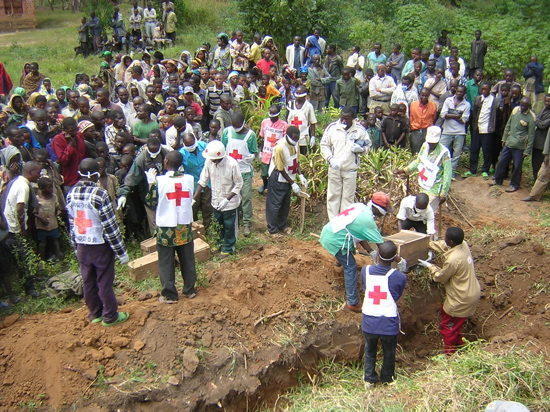
UN in the Congo, helping with Humanitarian Disaster. (Puppetgov Solution Revolution, 2009).


Related Class concepts that tie in with videos watched:
Challenges to coordinated response:
-multiple agencies-chaos or beneficial
-trained/competence
-immediate/long term needs assessment
-forensic specialists-immediate response
-attend to women/children first
-psychological trauma-short/long term.


Health Effects:
-family disruption
-family displacement
-diseases of poverty and overcrowding (infectious disease, mental health, violence-internal, external)
-malnutrition

Primary Health Care:
-equity/social justice
-community participation
-inter sectoral co-ordination
-appropriate technology

Elements:
-education
-nutrition
-maternal/child health
-sanitation
-immunization
-disease control
-medical care
-essential drugs

        Towards the end of class, we talked about the lack of specialized care, clean drinking water, food, shelter in many developing countries, and how it is hard to even decide what need to address first. This tied into later discussions about HIV/Aids being a pandemic, the problem of influenza, malaria, TB and how they are continuing to be a problem.

UN Peacekeepers helping with tactile and logistical support in the Congo,
helping to overpower Hutu rebels. (Puppetgov Solution revolution, 2009).


        Later in the week, my Health Promotion Project group met with our community health partner at The London Inter Community Health Centre. When discussing our project, Greg (our partner) shared a story about Brazil and Africa in the late 1980s as some background for the topic we were discussing, and it tied in with our class on Monday. He spoke about how both Countries were faced with an AIDs epidemic. On the global level, many strategies were talked about, for many different reasons with different rationales for each reason. Many countries chose different strategies and approaches. It was thought that a clinical/hierarchical approach would work in Africa. This strategy for health promotion was very prescriptive, (the North American nations had all the information and they were going to give it to Africa, and tell them what to do to fix the problem). The problem with this approach was that it didn't take into account that Africa's culture is very different than our Western societies. By not allowing for cultural differences the plan was destined to not work from the beginning.

        Brazil chose a social marketing approach, they used humor and nuns to fix their epidemic. They created an add campaign using chili peppers and put condoms on them. These pictures were posted on billboards all over the country and were well received by the people as chili peppers are a big aspect of their culture. The billboards were something they could identify with, and found funny.
The above picture shows how humour can sell an idea.
(Asylumunk, 2011).


        People respond to humour. The country also had nuns hand out condoms in public saying, 'here, its okay, use these, we culturally accept this'. Having the nuns hand out condoms showed that it was socially acceptable by the religious sects to use condoms and they were actually being encouraged. Showing cultural acceptance and openness meant that people used condoms and started to practise safe sex, therefore decreasing the prevalence of AIDs and HIV in Brazil.  In Africa and Brazil, cultural is of the utmost importance, by respecting and incorporating Brazil's culture into the advertisement campaign and Health Promotion strategy, things changed for the better. Using a European and North American approach in Africa didn't work because the people's culture was ignored, and billions of dollars were spent, to the detriment of the nations who spent it.

(Healthlink Worldwide, 2010).
    This story applies to what we have been talking about in class over the past few weeks, and also to the overall umbrella concept of Health Promotion. It is a real life story of how Health Promotion should be implemented. It shows the importance of respecting the cultures of those with which you are working, and protecting their wishes. Using the "SMART Objectives System" worked for Brazil who followed it. Their plan was S-specific, M-measurable, A-achievable, R-realistic, and was implemented in an efficient T-time frame. The plan in Africa was specific, and measurable, it was not, however, achievable, or realistic as it didn't respect the nation's culture and therefore would not work in an efficient time frame as the health promotion strategy/implementation was not well received. It is clear too that this plan was unsuccessful as the AIDs epidemic is still an unsolved, and on going worldly issue. This story shows how it is important to have a proper, and realistic framework before starting any health promotion strategy, and should be remembered and followed during a complex humanitarian disaster like the earthquake in Haiti that we discussed in class.


References

Asylumuk. (2011).15 adverts peta won't like one bit. Retrieved February 20, 2011, from

        http://www.asylum.co.uk/2010/03/01/14-ads-featuring-animals-peta-wont-like-one-little-bit/

Healthlink Worldwide. (2010). HIV, AIDS and sexually transmitted infections. Retrieved February 20

        2011, from http://www.aidsaction.info/aa/aa04.html


Nienaber, Georgianne. (2009, May 29). UN: arms from sudan add to congo humanitarian disaster. The

        Huntington Post. Retrieved from http://www.blogger.com/post-edit.g?

         blogID=2190464285898886591&postID=902279511867305420


Puppetgov Solution Revolution. (2009). UN backed congo military offensive a "humanitarian disaster".

       Retrieved February 20, 2011, from http://www.puppetgov.com/2009/10/13/un-backed-congo-

       military-offensive-a-humanitarian-disaster/


Thursday, February 17, 2011

Stephen Lewis

Above, Stephen is sitting with a child in
Africa on one of his many visits. (Nih Record, 2009). 
      In class we ha e talked about Stephen Lewis with a brief focus on his service within the UN (serving for a special branch for HIV/AIDS in Africa. We discussed how has has always had a specially focus for working with women and children. I really wanted to learn more about Stephen, so as part of my work outside of the classroom this week, I have decided to research his background and a few of his contributions.

      Stephen was born November 11th, 1937. He is a the son of an NDP leader (David Lewis) and is a Canadian politician, and a diplomat. In 1963, at the age of 26, he was elected to Ontario legislature while he was still a student at the UofT (The University of Toronto). He was elected leader of the NDP in 1970.

      Lewis worked as a labour mediator, columnist and broadcaster, and was appointed Canadian Ambassador to the UN in 1984 where he stayed until 1988. He was Deputy Director of UNICEF From 1995-1999 and he heads the Stephen Lewis Foundation, a charity that helps victims of HIV/AIDS in Africa. In 2003, he was awarded The Order of Canada (for recognition of significant achievements and remarkable service) it is Canada's highest honour for lifetime achievement. Currently, he is a Visiting Professor at Ryerson University in Toronto. 


Above, Stephen smiles with an African woman. (AID Watch,  2009).


Stephen Lewis' organization can be visited at: http://www.stephenlewisfoundation.org/

      On March 27th, 2004 he received the United Nations Association in Canada Pearson Medal of Peace for his contribution to international service in fighting HIV/AIDS.

         I have been focusing on Stephen's talks on fighting HIV/AIDS and as a result have been viewing a lot of uTube videos of Stephen's inspiring speeches. The first video talks about the huge amount of spending that is being done by North Americans which is going towards two different conflicts. It addresses our need to put that money or allocate our funds in a more productive manner to things like pandemics, and other matters of global health. The second speaks about our failure to fix things, like the number of omen who die in childbirth per year, our need to turn back pandemics, and our need for solidarity with those who are struggling. I found it very interesting to hear about "The Millennium Goals" and agree with the fact that the single most important struggle for these developing nations is gender equality. We have all the information and the ability to stop this, but we just need to educate people and put these things into practise!


References

AID Watch. (2009). Africa men call for un to protect white women. Retrieved February 27, 2011, from

       http://aidwatchers.com/2009/05/african-men-call-for-un-to-protect-white-women/

Nih Record. (2008). Former un envoy lewis to speak on hiv/aids in africa. Retrieved February 27, 2011,

        from http://nihrecord.od.nih.gov/newsletters/2008/05_02_2008/story6.htm

Tripod. (2011). Biography of Steven Lewis. Retrieved February 20, 2011 from, http://greatest-

        canadian.tripod.com/id1.html

The Stephen Lewis Foundation. (2010). Retrieved February 27, 2011 from,

        http://www.stephenlewisfoundation.org/

Youtube. (2007). Stephen Lewis, Aids-Free World at Duke University [Video file]. Retrieved from

        http://www.youtube.com/watch?v=vYmeR1nCzt0&feature=player_embedded

Youtube. (2007). Stephen Lewis- UN HIV Envoy to Africa [Video file]. Retrieved from

         http://www.youtube.com/watch?v=gz16oP4cb9E&feature=player_embedded

Disease, Disability, and Primary Health Care. The U.S.A Primary Health Care System vs. Canada

     In class this past week, we focused on Primary Care which is the term for the health services that play a central role in the local community. The Primary Health Care Team is a first point of consultation for all patients. I found it very coincidental that Primary Health Care was discussed in class the same week that I had been sick and was trying to obtain an appointment with my family Doctor. I was very frustrated by the whole process and expressed this frustration with my cousin (who currently goes to school in Boston) I told her how upset I was about how long I had to wait to get an appointment. She commented on the fact that she has yet to hear of anyone in her area who has had to wait for a doctor.

Medical Image. (Vietnam's Talking points, 2010)
     I thought this was bizarre as there is much talk about how those who do not even have health care are never even seen by a doctor because they can't afford it/don't have the coverage. When I really started to contemplate this fact, however, I came to the conclusion that this was the case because my cousin goes to school in the most affluent part of Boston (in Wesley). I clued in that maybe no one has had to wait because all the people my cousin associates with have extensive coverage/the money to foot a doctor's bill.


The above depicts the Overall Country Health Care Rankings for 2010.
(Overall Country rankings, 2010). 


In essence, our class on Primary Health Care and my conversation with both my cousin and the secretary at my Doctor's office made me hungry for more information with regard to how the Canadian and American Health Care Systems differ. I also wanted to find out which system really is the best. I wondered if the Canadian Health Care System really is as good as people make it out to be..... All of those questions will be addressed in this week's reflection. In class we discussed that Primary Health Care Elements include: education, sanitation, maternal/child health (a predominant issue), immunization, disease control, medical care, essential drugs.


Philosophy of Primary Health Care as discussed in class goes as follows:
-Equity/social justice
-Community participation
-Inter sectoral coordination-Working with other groups or people outside your specialty (like a health care worker working with a geographer. This concept is important as the health care team is a dynamic group of people, all with a different focus. When brought together the team creates a dynamic mosaic). If the health care team didn't work together there would be difficulty with social net, immunizations (vaccines), government, politics, education.
-Appropriate technology- Has to be related to the group you’re working with.

............I will be looking into whether this philosophy is really being put into practise in both the Canadian and American Health Care Systems.

Morbidity and Mortality
-Compare and contrast the causes of morbidity (disease) and mortality (death) across.......I will be comparing and contrasting the causes of morbidity and mortality rate of both the American and Canadian Health Care Systems.
Developed Countries:
· Depression
· Ischemic heart disease
· Cerebrovascular disease
· Lung cancer
Developing low mortality
· Depression
· Cerebrovascular disease
· Ischemic heart disease
· Chronic obstructive lung disease
Developing high mortality
· Depression
· Pneumonia
· HIV/AIDS
· Ischemic heart disease
The above differentiate with children and adults. 

Common causes of illness in children:
Lack of immunizations
Neonatal care
Common causes of illness in Adults:
Lifestyle factors
Tobacco, alcohol

There are similar trends between developed and developing countries. Developed countries have too much, smoking, access to food (and not healthy). People eat what is quick and available. We are also now starting to deal with baby-boomer population of chronic diseases.....In developing nations, people don’t reach ages old enough to deal with these diseases

Chronic Disease as discussed in class:
-Cardiovascular disease
-Skeletal based diseases
-Cancer
Different in developing countries (causes of death)
-Affordability of vaccines
-Re hydration therapy
-Still troubled with infectious diseases
-Macro nutrients, and micro nutrients malnutrition
-In-proper fetal care (disadvantaged and malnourished from birth)..... Don’t grow normally and therefore spend the rest of their life trying to catch up and never succeed.
Education to mothers on breastfeeding
Proper nutrition
Increases mental capacity, immune systems

       Global Middle Class as discussed in class- Another question that I will be attempting to answer is who the current health care systems in both the U.S.A and Canada affect the middle class of both populations. In class it was discussed that:
-Income/economic health is one of the great determinants of health of the population
-Education- is gender relevant in terms of developing countries
-Economic base- people are able to provide better income, better services, which encompasses a better health care system.
-Per capita (per person).
Different levels of poverty
-If there is a job to get, then there is a better opportunity
-Domino effect-chain reaction that comes about when a small change causes a similar change nearby, which then will cause another similar change, and so on. (I'm wondering if problems in Health Care Systems happen this way?)
-Economics, education, literacy, government, policy and foreign trade policy
Signifies a meaningful income, or impact
China still a communist country-No Universal Health Care. Canada has universal health care......is it really better than the American system (Privatized Health Care)?

Which is better? The Canadian or American healthcare systems? (Face Painting Ideas, 2007).


My own research and the Comparison of the American vs. Canadian Health Care Systems is seen below:
Access to Health Care in Both Canada and the U.S.A is not a problem. With regard to overall health of both nations, it has been found that life expectancy is longer in Canada, and its infant mortality rate is lower than that of the U.S., but there is debate about the underlying causes of these differences. Is it the health care system or merely the life styles of the people being surveyed that contribute to this fact? It is true that United States spends much more money on health care than Canada, on both a per-capita basis and as a percentage of GDP. For instance, In 2006, per-capita spending for Health Care in Canada was $3,678 (American dollars)....... in the U.S, spending was $6,714 (American dollars).....But, again, do these numbers mean that since the U.S.A is paying more, their health care is better and their wait times are lower? I think, based on my research that the health care is not better, comparing the two countries. The wait times in the U.S.A are much lower if you have the money/insurance to pay in the U.S.A, where as in Canada, the wait times are equal for everyone because our Health Care is universal (for all members of society). The U.S. spent 15.3% of GDP on health care in the same year as the above statistic (2006); Canada spent 10.0%. In 2006, 70% of health care spending in Canada was financed by government, versus 46% in the United States.

The Above Total Health Expenditure Per Capita in American dollars. (Wapedia 2007).

I found that where Canada and the U.S.A differ most is the different mix of funding mechanisms that exist. For instance, Canada's universal "single-payer health care" (financing health care from a single insurance pool- in this case, government run. Our entire population is financed from a pool to which many parties--employees, employers, the state-have contributed) this covers about 70% of expenditures, and the Canada Health Act requires that all insured persons be fully insured, without co-payments or user fees, for all medically necessary hospital and physician care. About 91% of hospital expenditures and 99% of total physician services are financed by the public sector in Canada. This mix of funding allows for Canadians to be covered, equally, and without preferential treatment. Ophthalmology and dentistry are not covered in Canada, but are included in many people's heath benefits from their jobs. As a result, the expenditures seen mainly come from these two fields. In the U.S.A, there is a mixed public-private system. They are actually one of only two nations in the Organisation for Economic Co-operation and Development (OECD), is an international economic organisation of 34 countries founded in 1961 to stimulate economic progress and world trade to not have Universal Health Care, as Mexico established a program in 2008.

In the U.S.A, people are treated more quickly, while others are not treated at all, due to U.S., direct government funding of health care being limited to Medicare (coverage to those 65 and over who meet specific criteria), Medicaid (for those who have low incomes and resources), and the State Children's Health Insurance Program (SCHIP). Essentially, the U.S covers eligible senior citizens, the very poor, disabled persons, and children......this leads back to my question about comparing the care given to the middle class of both Canada, and the U.S.A. The U.S.A federal government also runs the Veterans Administration and a Military Health System .....but again, what about those who are not quite poor enough to meet the criteria for Medicaid, are too old for the child aid and too young for Medicare etc?........If they don't work, run their own business, or don't get offered insurance through work, they must purchase it themselves.....those who are unable to purchase it themselves seem to be out of luck, where as Canadians don't suffer the same fate........And the latter is where I have found my loop hole, and the main difference in the two systems (in my opinion). Only about 59% of the U.S.A has access to private Health Care through employers, and these numbers are continuing to dwindle-especially due to the current American economic situation. There are estimates that only about 25% of the uninsured in the U.S. are eligible for these programs but remain unenrolled.

The below link really helped to give me some background and shed some light on the Health Care Systems of both Canada and the U.S.A.-with a focus on comparing the Primary Health Care of each.


References

Face Painting Ideas. (2007). Flag Face Paint. Retrieved February 30, 2011, from

     http://facepaintingideas.net/category/flag-face-painting/

Youtube. (2009). Comparing Canadian and American Health Care [Video file]. Retrieved from 

      http://www.youtube.com/watch?v=ARxjQ3IRqvg&feature=player_embedded

Wapedia. (2007). Comparison of the Health Care Systems in Canada and the United States. Retrieved

       February 27, from

        http://wapedia.mobi/en/Comparison_of_Canadian_and_American_health_care_systems

Vietnam's Talking Points. (2010). Socialist Healthcare System. Retrieved February 30, 2011, from

         http://talk.onevietnam.org/vietnam’s-socialist-healthcare-system/

Tuesday, February 1, 2011

Issues in Context (Socio-Ecologial Perspective)


        The main goal of "Issues in Context" is to understand health from a socio-ecological perspective, like how health and health behaviours are shaped by the context in which they exist. This week, I have been wondering where exactly that context came from in the first place...... I've been wondering what the history of health as we know it today is, and how it became this way. How did our ancestors develop what health is, how have these concepts changed over time? I've been wondering how health is tied into other huge, global institutions, we've looked into how it ties into the government, but what about other huge institutions like the church (who's whole purpose is to serve, people look to it for spiritual guidance/spiritual health)? What are they currently, and what have they in the past done to promote health, and wellness (health can extend all the way from physical to mental, and spiritual wellness). The church is in essence the main spiritual health promotor in every country on earth. I plan on looking at what spiritual health is and I would like to know why some institutions are so wealthy, and have so much money. How did the church become such a powerful, guiding force in some people's lives? Where exactly does all the money that people give the church go? Could more of that money be directed back towards the people, health promotion, or missions rather than internalized by the institution itself? People continue to give the church money, why couldn't that money be directed in a different direction if the church is all about helping those who need it? Were the church and government ever tied together?

           Through my research, I have found that as with most of our history, things seem to stem back to the Roman Empire. The church was illegal until late in the empire's life. No one believed in the Roman Gods any more, and as the Roman Empire started to fall/the people started to rebel, Romans in charge tried to use the church to unite people. The Empire continued to fall under the weight of its own corruption. French and German tribes looted the Empire, and really the only buildings they avoided were the churches. Churches had books, which were worthless to many at the time (most people couldn't read). The Empire was devastated, but they still needed laws, people needed to be married, buried, people needed guidance. This is the point where the church started to become popular, and a guiding force within people's lives. Spiritual health is unique to an individual. It is your spirit (the deepest part of you) that allows you to make sense of the world. It helps a person know who they really are, and what their purpose for living is. When everything around people starts to crumble, time and time again, people turn to the church for guidance, meaning, and a purpose in life. This is an age-old example of how political conflict shapes individual / community health experiences.

A map of the Roman Empire. (Blindloop.com,  2009).

        Throughout the medieval times, the main buildings left standing from the Roman Empire were churches. There was a lot of superstition during this time and the church was still not a hugely popular institution. It is interesting to note that the church never set out to be a big powerful institution, its goal was merely to serve people, which is what it continued to do throughout medieval times. It fell into it being powerful while trying to serve people. In time it became the most powerful institution in Europe, and then the Renaissance came which was a cultural movement that spanned roughly the 14th to the 17th century, it was essentially, a gradual time of educational reform, there were changes in art, there was social and political change. People's ideas of health started to change, people's spirituality grew as more and more people were able to read (things like the bible, medical books). This piece of history serves as an answer to one of my questions. A lot of the wealth the church has is tied up in their buildings, art, and their books. They are a part of their history, and that is where a good portion of the money the church receives goes......there are lots of missions, now, worldwide over the past few years, the church has actually been been losing money. Even if the church were to sell some of their buildings, it is difficult to sell them as churches are big expensive buildings, on large plots of land, that would be expensive to tear down, and are also expensive to heat, and continue to care for (paying for water, roofing, even lawn mowing). The church is a huge bureaucracy/institution and it is trying to get back to its roots, to serve the people teach the words of Jesus Christ. This is ironic because Jesus was revolutionary, he rallied against the institutions of the day, and today, so the question is, how can the church be an institution and also preach the words of a revolutionary character like Jesus Christ?

          As far as my last question, for a very long time, the government and the church were both one unit, so all decisions were made together, (even those about health promotion and health behaviours). The Vatican is still its very own nation, with the head of state being the Pope.

Above is a photograph of Vatican City. (Blindloop.com, 2009)

          A Historic example of how the church and government are intertwined stems back to Central America. When the Spanish conquered the native tribes of Guatemala government was set up, and the governors running Guatemala on behalf of Spain, stayed and established independent countries. This meant that the Spanish were running both the church, and the government, because when Rome had fought Spain years earlier, the Spanish had forced the Pope to sign a document declaring that they got to choose/appoint their own bishops, they also got to elect their own governments. Therefore, both were under control of the Spanish. This meant that there would be a regular priest working with the poor, promoting health, and faith and bishops working with the government, and the elites to keep the people poor. In these historic cases, health promotion was shaped by the context in which it existed, (nothing really happened as people were kept poor and priests were left without power). All of this continued to happen until the people started to rebel. In an effort to keep the peace, the government appointed Oscar Romero to be the next bishop, thinking that he was neutral (not on the side of the Spanish, but also not strong enough to fight for the poor).....The government was wrong about Oscar, and he and the people rebelled. Because Oscar wasn't afraid to speak out, he was assassinated while saying mass. 

Rebellions during Oscar Romero's time. (Oscar Arnfulo Promero Y Galdamez).

       This is another example of how political conflict has shaped individual / community health experiences. Events like these continued throughout the ages, because throughout our history, one thing has remained true, people seek power, health and wealth. People have also had a‘choice’ when it comes to health promotion throughout history. People have always been able to choose health, and choose to care for their bodies, the same way that people can choose to seek power health and wealth. Our world seems to be all about power, politics and money, which as seen above stems back as far as our history books take us. The people and places are different, but the common elements are all the same. Like a romantic comedy. For instance, in this current day and age, there is really no reason why you can't have health/health care for everyone. It is not a medical problem it is a problem with the people running the institutions, which will be discussed in later blogs!

References

Blindloop.com. (2009). 5 smallest countries of the world. Retrieved February 1, 2011, from

      http://www.blindloop.com/index.php/2009/12/5-smallest-countries-of-the-world/


Oscar Arnfulo Romero Y Galdamez. (2011). Archbishop oscar arnfulo romero. Retrieved February 1, 

     2011, from  http://www.marypages.com/RomeroEng.htm

Sermons and Writings of Victor Shepard. (2011). Oscar romero. Retrieved February 1, 2011, from

      http://www.victorshepherd.on.ca/Heritage/Oscar%20Romero.htm

Third World Traveller. (2010). Oscar romero- el salvador. Retrieved February 1, 2011, from

      http://www.thirdworldtraveler.com/Heroes/Oscar%20_Romero.html