Hello,
For my Global Health Couse (3090B) at the University of Western Ontario we were asked to create a Health Promotion Blog to document key learnings throughout the course. My blog contains 13 main posts/topics that I have added to, changed and re arranged throughout the course. Happy Reading!
~Clare McNeil
Monday, April 4, 2011

Wednesday, March 23, 2011
How We (Canada) Got Universal Health Care
 |
| Otto Von Bismark (Knowledge Rush, 2009). |
We have spoken quite a bit in class about Health Care and Global Health in general, but have not delved deeply into the topic of how Universal Health Care came about in Canada. I would like to know how Universal Health Care came about, which is why the below post will be dedicated to my own personal findings on how and when Health Care came about in Canada.
First off, what is Universal Health Care exactly?
Universal Health Care is a health insurance program in many countries (not including the U.S.A) that is financed by taxes and administered by the government to provide comprehensive health care that is accessible to all citizens of that nation. The term Universal Health Care refers to an organized health-care system that is built around the principle of universal coverage for all members of that particular society. It combines mechanisms for health financing and service provision.
What is the History of Universal Health Care?
Many think of Germany and Otto von Bismarck's social legislation as having the world's oldest Universal Health Care System. Otto, a German-Prussian statesman/a central figure in world affairs lived from April 1st, 1815 – July 30, 1898. He brought about the first welfare state in the 1880s. Otto also implemented bills such as Health Insurance Bill in1883, Accident Insurance Bill in 1884, and Old Age and Disability Insurance Bill in 1889.
In Britain, the National Insurance Act of 1911 symbolized the first movement towards Universal Health Care. The act is seen as one of the foundations of modern social welfare in the United Kingdom.
Most current Universal Health Care systems were put in place following World War Two to reform Health Care (as we have touched on in class). The idea was to make health care available and accessible to all citizens. In 1948, Article 25 of the Universal Declaration of Human Rights was signed by many countries, however, the U.S.A did not approve of the social and economic rights sections, including Article 25's right to health.
Article 25 of the Universal Declaration of Human Rights states:
(1) Everyone has the right to a standard of living adequate for the health and well-being of himself and of his family, including food, clothing, housing and medical care and necessary social services, and the right to security in the event of unemployment, sickness, disability, widowhood, old age or other lack of livelihood in circumstances beyond his control.
(2) Motherhood and childhood are entitled to special care and assistance. All children, whether born in or out of wedlock, shall enjoy the same social protection.
What are some Implementation Comparisons between Canada and other Countries who have Universal Health Care?
The government is more heavily involved in some Health Care systems than in others, in the UK, Spain, Italy and the Northern European countries, the government has a high degree of involvement in the delivery of health care services. Access to these systems is based on residence rights not on the purchase of insurance. Other countries have contributory insurance rates related to salaries or income, and are usually funded by employers and beneficiaries jointly. Sometimes the health funds are from a mixture of insurance premiums, salary related mandatory contributions by employees and by government taxes. These insurance based systems tend to reimburse private or public medical providers, often at heavily regulated rates.
Universal Health Care can be implemented in different ways, because it is a broad concept. What remains the same, however, is the fact that the government is trying to extend access to Health Care through legislation/regulation and taxation. Regulation means to direct what care/to whom it must be provided. Governments also maintain this by setting minimum standards. Some programs are paid for entirely out of tax revenues. In others, tax revenues are used either to fund insurance for the very poor or for those needing long term chronic care.
The History of the Canadian Universal Health Care System:
Thomas Clement Douglas, has been known to many as the father of Health Care/Medicare in Canada. He was born on October 20, 1904 and died February 24, 1986.
Tommy started out as a Scottish Baptist minister, but became leader of the CCF (Saskatchewan Co-operative Commonwealth Federation) in 1942. He went on to become the 7th Premiere of Saskatchewan, and became the first federal leader of the NDP (New Democratic Party from 1961-1971).
References
Cox and Forkum (2007). The benefits of universal healthcare. Retrieved March 21, 2011, from
coxandforkum.com
Jesustians (2005). Tommy douglas. Retrieved March 21, 2011, from
http://www.jesustians.com/main.htm
United Nations (2011). The universal declaration of human rights. Retrieved March 20, 2011, from
http://www.un.org/en/documents/udhr/index.shtml
Many think of Germany and Otto von Bismarck's social legislation as having the world's oldest Universal Health Care System. Otto, a German-Prussian statesman/a central figure in world affairs lived from April 1st, 1815 – July 30, 1898. He brought about the first welfare state in the 1880s. Otto also implemented bills such as Health Insurance Bill in1883, Accident Insurance Bill in 1884, and Old Age and Disability Insurance Bill in 1889.
 |
| Universal Health Care comic displaying the benefits of Universal Health Care (Cox and Forkum, 2007) |
In Britain, the National Insurance Act of 1911 symbolized the first movement towards Universal Health Care. The act is seen as one of the foundations of modern social welfare in the United Kingdom.
Most current Universal Health Care systems were put in place following World War Two to reform Health Care (as we have touched on in class). The idea was to make health care available and accessible to all citizens. In 1948, Article 25 of the Universal Declaration of Human Rights was signed by many countries, however, the U.S.A did not approve of the social and economic rights sections, including Article 25's right to health.
 |
| The Universal Declaration of Human Rights Document, held by Eleanor Roosevelt, who considered it to be her greatest accomplishment (Franklin and Eleanor Roosevelt Institute, 1998) |
Article 25 of the Universal Declaration of Human Rights states:
(1) Everyone has the right to a standard of living adequate for the health and well-being of himself and of his family, including food, clothing, housing and medical care and necessary social services, and the right to security in the event of unemployment, sickness, disability, widowhood, old age or other lack of livelihood in circumstances beyond his control.
(2) Motherhood and childhood are entitled to special care and assistance. All children, whether born in or out of wedlock, shall enjoy the same social protection.
What are some Implementation Comparisons between Canada and other Countries who have Universal Health Care?
The government is more heavily involved in some Health Care systems than in others, in the UK, Spain, Italy and the Northern European countries, the government has a high degree of involvement in the delivery of health care services. Access to these systems is based on residence rights not on the purchase of insurance. Other countries have contributory insurance rates related to salaries or income, and are usually funded by employers and beneficiaries jointly. Sometimes the health funds are from a mixture of insurance premiums, salary related mandatory contributions by employees and by government taxes. These insurance based systems tend to reimburse private or public medical providers, often at heavily regulated rates.
Universal Health Care can be implemented in different ways, because it is a broad concept. What remains the same, however, is the fact that the government is trying to extend access to Health Care through legislation/regulation and taxation. Regulation means to direct what care/to whom it must be provided. Governments also maintain this by setting minimum standards. Some programs are paid for entirely out of tax revenues. In others, tax revenues are used either to fund insurance for the very poor or for those needing long term chronic care.
 |
| The above figure is a depiction of all the countries who have Universal Health Care (Shown in blue), Countries attempting to implement Universal Health Care (shown in green), Countries with no Universal Health Care system (shown in grey) and Countries where coverage is provided by the U.S.A through war funding (shown in orange-Iraq and Afghanistan). (AOL. Gadling, 2011). |
The History of the Canadian Universal Health Care System:
 |
| Tommy Douglas, the father of Health Care in Canada. (Jesustians, 2005) |
Tommy started out as a Scottish Baptist minister, but became leader of the CCF (Saskatchewan Co-operative Commonwealth Federation) in 1942. He went on to become the 7th Premiere of Saskatchewan, and became the first federal leader of the NDP (New Democratic Party from 1961-1971).
In about 1946 Saskatchewan introduced what would become universal coverage. The province had suffered a shortage of doctors, and many towns were having to subsidize a Doctor to practise there. This lead to something called The Municipal Doctor Program. Union Hospitals were then opened which had similar costs as far as subsidizing. In 1946, Tommy, who at the time was part of the CCF government in Saskatchewan passed the Saskatchewan Hospitalization Act. This act guaranteed free hospital care for much of the population. At the time, it had been Tommy Douglas' hope to provide Universal Health Care, but the province didn't have have the money. The implementation of this act, however, was the boost that Canada needed in terms of Health Care and set the Country up for future success with regard to achieving Universal Health Care!
In 1950, Alberta created a program similar to Saskatchewan's in 1948 to provide prepaid health services with provided Health Care to 90% of the population. Following these models, In 1957, John Diefenbaker (Canada's 13th Prime Minister) passed the Hospital Insurance and Diagnostic Services Act which funded 50% of the cost of programs within the Provinces. The HIDS (Hospital Insurance and Diagnostic Services) Act outlined five conditions:
1. public administration
2. comprehensiveness
3. universality
4. portability
5. accessibility
...........These remain the pillars of the Canada Health Act.
In 1950, Alberta created a program similar to Saskatchewan's in 1948 to provide prepaid health services with provided Health Care to 90% of the population. Following these models, In 1957, John Diefenbaker (Canada's 13th Prime Minister) passed the Hospital Insurance and Diagnostic Services Act which funded 50% of the cost of programs within the Provinces. The HIDS (Hospital Insurance and Diagnostic Services) Act outlined five conditions:
1. public administration
2. comprehensiveness
3. universality
4. portability
5. accessibility
...........These remain the pillars of the Canada Health Act.
By 1961, all ten provinces had agreed to start HIDS Act programs. In Saskatchewan, the act meant that half of their current program would now be paid for by the federal government. It was decided that this freed money should be used to extend the Province's health coverage to include physicians........ It is because of this that Tommy Douglas is widely known as the creator of Medicare and the father of Health Care in Canada.
In 1964, Justice Hall recommended the nationwide adoption of Saskatchewan's model of Public Health Insurance and in 1966, the Liberal minority government of Lester B. Pearson (Canada's 14th Prime Minister) created the program. The federal government payed 50% of the costs for Health Care, and the provinces were responsible for paying the other half. So all in all, our health Care system can be attributed to Tommy Douglas, John Diefenbaker and Lester B. Pearson!
In 1964, Justice Hall recommended the nationwide adoption of Saskatchewan's model of Public Health Insurance and in 1966, the Liberal minority government of Lester B. Pearson (Canada's 14th Prime Minister) created the program. The federal government payed 50% of the costs for Health Care, and the provinces were responsible for paying the other half. So all in all, our health Care system can be attributed to Tommy Douglas, John Diefenbaker and Lester B. Pearson!
 |
| Tommy Douglas, Leader of the NDP Party until 1971 (Canadian Museum of Civilization, 2010) |
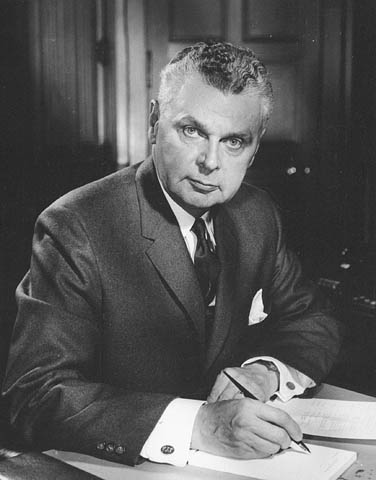 |
| John Diefenbaker, Canada's 13 Prime Minister (Library and Archives Canada, 2002) |
 |
| Lester Pearson, 14th Prime Minister of Canada (Britannica Academic Edition, 2011) |
References
Aol, Gadling (2011). What countries have universal health care. Retrieved March 22, 2011, from
http://www.gadling.com/2007/07/05/what-countries-have-universal-health-care/
Canadian Museum of Civilization (2010). Tommy douglas. Retrieved March 24, 2011, from
http://www.civilization.ca/cmc/exhibitions/hist/biography/biographi273e.shtml
Cox and Forkum (2007). The benefits of universal healthcare. Retrieved March 21, 2011, from
coxandforkum.com
Franklin and Eleanor Roosevelt Institute (1998). Eleanor Roosevelt. Retrieved March 21, 2011, from
http://www.udhr.org/history/biographies/bioer.htm
ITA Geographic (2004). Otto von bismarck. Retrieved March 20, 2011, from
http://www.photius.com/countries/germany/society/germany_society_development_of_the_
Jesustians (2005). Tommy douglas. Retrieved March 21, 2011, from
http://www.jesustians.com/main.htm
Knowledgerush (2009). Otta von Bismark. Retrieved March 1, 2011, from
http://www.knowledgerush.com/kr/encyclopedia/Otto_von_Bismark/
Library and Archives Canada (2002). John diefenbaker. Retrieved March 24, 2011, from
http://www.collectionscanada.gc.ca/2/4/h4-3325-e.html
The Free Dictionary By Farlex (2011). Universal Health Care. Retrieved March 1, 2011, from
http://medical-dictionary.thefreedictionary.com/Universal+health+care
United Nations (2011). The universal declaration of human rights. Retrieved March 20, 2011, from
http://www.un.org/en/documents/udhr/index.shtml
Wednesday, March 9, 2011
Food Security
For our Community Project, my group has been working with the London InterCommunity Health Centre to develop an outcomes-based Food Strategy Action Plan for the Health Centre. The Health Centre is embarking on a process to develop an outcomes-based Food Security Strategy, and the plan was for us to do the ground work, research, and initial survey to begin this Food Security Strategy. I have been feeling like I don't have a solid understanding of exactly what Food Security is, so this week I have decided to delve deeper into the topic/look at how Food Security applies to Canada.
Food Security is: “a condition in which all people, at all times, have physical and economic access to sufficient, safe and nutritious food to meet their dietary needs and food preferences for an active and healthy life” as defined by the Food and Agriculture Organization of the United Nations.
Important Facts:
- 9 % or 1.1 million Canadian households = 2.7 million Canadians, experience food insecurity
- Families with children = 5.2% child-level food insecurity
According to The Canadian Community Health Survey:
- Food insecurity is more common in households that contain:
Children = 10.4%
Without children = 8.6%
-Food Insecurity is especially common in:
Households led by lone mothers= 25%
Aboriginal households (with and without children) = more likely to be food insecure than non-
Aboriginal households
Factors that lead to hunger in a family:
-Family acquiring another mouth to feed either through birth or family melding
-Change in number of parents in the home
-Loss of job
-Change in employment hours
-Health of an adult or child declining
· **It has been found through studies that getting out of hunger, happens generally only under one condition = the mother of the household began a full-time job which caused the family’s income to rise.
-Dietary insufficiencies are more common among food insecure households.
-Increased chance of chronic disease and difficulties in managing these diseases occurs in food insecure households.
-Heart disease, diabetes, high blood pressure and food allergies are more common in food insecure households, even when factors such as age, sex, income and education are taken into account.
- Food insecurity produces stress and feelings of uncertainty that have health-threatening effects.
In Food Insecure Households:
- 80% are more likely to report having diabetes
- 60% are more likely to report high blood pressure
- 70% are more likely to report food allergies than households with sufficient food
-Food banks = last resort support to food insecure households and exist as a consequence of failed public policies
-As of March 2009- 800,000 Canadians used food banks
**Food Insecurity is almost always caused by lack of economic resources- (things of value) that an economy (or business) may have available. Used to supply and produce goods/services to meet the ever-changing needs/wants of individuals (in the case of a business) and society as a whole**
Alaimo, K., Olson, C. M., & Frongillo, E. A., Jr. (2001). Food insufficiency and American
school-aged children’s cognitive, academic, and psychosocial development. Pediatrics,
108, 44–53.
Allen, P. (1999). Reweaving the food security safety net: Mediating entitlement and
entrepreneurship. Agriculture and Human Values, 16, 117–129.
Bellows, A. & Hamm, M. (2011). Thinking Outside of the Breadbox. Food Security Network (1-
4).
Child and Youth Network (2011). London’s food charter. Retrieved February 18, 2011, from
Morland, K., Wing, S., Deiz Roux, A., & Poole, C. (2002). Neighborhood characteristics
associated with the location of food stores and food service places. American Journal of
Preventative Medicine, 22, 23–29.
Siefert, K., Hein, C. M., Corcoran, M. E., & Williams, D. R. (2001). Food insufficiency and the
physical and mental health of low-income women. Women Health, 32, 159–177.
The London InterCommunity Health Centre (2011). Retrieved February 18, 2011, from
http://lihc.on.ca/
United States Department of Agriculture Food and Nutrition Service. (n.d.). Food
environment atlas data. Retrieved from http://www.ers.usda.gov/FoodAtlas/
downloadData.htm
United States Department of Agriculture. (2009a). Food security in the United States: Key
statistics and graphs. Retrieved from http://www.ers.usda.gov/Briefing/
FoodSecurity/stats_graphs.htm
 |
| Food Security, (Emerald Research You Can Use, 2011). |
Food Security is: “a condition in which all people, at all times, have physical and economic access to sufficient, safe and nutritious food to meet their dietary needs and food preferences for an active and healthy life” as defined by the Food and Agriculture Organization of the United Nations.
Important Facts:
- 9 % or 1.1 million Canadian households = 2.7 million Canadians, experience food insecurity
- Families with children = 5.2% child-level food insecurity
According to The Canadian Community Health Survey:
- Food insecurity is more common in households that contain:
Children = 10.4%
Without children = 8.6%
-Food Insecurity is especially common in:
Households led by lone mothers= 25%
Aboriginal households (with and without children) = more likely to be food insecure than non-
Aboriginal households
Factors that lead to hunger in a family:
-Family acquiring another mouth to feed either through birth or family melding
-Change in number of parents in the home
-Loss of job
-Change in employment hours
-Health of an adult or child declining
· **It has been found through studies that getting out of hunger, happens generally only under one condition = the mother of the household began a full-time job which caused the family’s income to rise.
-Dietary insufficiencies are more common among food insecure households.
-Increased chance of chronic disease and difficulties in managing these diseases occurs in food insecure households.
-Heart disease, diabetes, high blood pressure and food allergies are more common in food insecure households, even when factors such as age, sex, income and education are taken into account.
- Food insecurity produces stress and feelings of uncertainty that have health-threatening effects.
In Food Insecure Households:
- 80% are more likely to report having diabetes
- 60% are more likely to report high blood pressure
- 70% are more likely to report food allergies than households with sufficient food
 |
| Food Insecure Households by Province, (Health Canada, 2008). |
-As of March 2009- 800,000 Canadians used food banks
**Food Insecurity is almost always caused by lack of economic resources- (things of value) that an economy (or business) may have available. Used to supply and produce goods/services to meet the ever-changing needs/wants of individuals (in the case of a business) and society as a whole**
 |
| Food Insecurity Framework. (Human Resources and Skills Development Canada, 2006) |
References
Alaimo, K., Olson, C. M., & Frongillo, E. A., Jr. (2001). Food insufficiency and American
school-aged children’s cognitive, academic, and psychosocial development. Pediatrics,
108, 44–53.
Allen, P. (1999). Reweaving the food security safety net: Mediating entitlement and
entrepreneurship. Agriculture and Human Values, 16, 117–129.
Bellows, A. & Hamm, M. (2011). Thinking Outside of the Breadbox. Food Security Network (1-
4).
Child and Youth Network (2011). London’s food charter. Retrieved February 18, 2011, from
http://www/london.ca/Child Youth Network/
Kaiser, M (2011). Food security and community. Routledge Taylor and Francis Group (62-76).
Kamphuis, C. B., Giskes, K., de Bruijn, G. J., Wendel-Vos, W., Brug, J., & van Lenthe, F. J.
(2006). Environmental determinants of fruit and vegetable consumption among adults: A
systematic review. British Journal of Nutrition. 96, 620–635.
Emerald Research you Can Use (2011). Food security. Retrieved March 6, 2011, from
http://www.emeraldinsight.com/journals.htm?articleid=1881660&show=html
Health Canada (2008). Food Insecure Households. Retrieved March 6, 2011, from
http://www.hc-sc.gc.ca/fn-an/surveill/nutrition/commun/income_food_sec-sec_alim-
eng.php
http://www.hc-sc.gc.ca/fn-an/surveill/nutrition/commun/income_food_sec-sec_alim-
eng.php
Human Resources and Skills Development Canada (2006). Food insecurity framework.
Retrieved March 5, 2011.
Retrieved March 5, 2011.
Kaiser, M (2011). Food security and community. Routledge Taylor and Francis Group (62-76).
Kamphuis, C. B., Giskes, K., de Bruijn, G. J., Wendel-Vos, W., Brug, J., & van Lenthe, F. J.
(2006). Environmental determinants of fruit and vegetable consumption among adults: A
systematic review. British Journal of Nutrition. 96, 620–635.
Morland, K., Wing, S., Deiz Roux, A., & Poole, C. (2002). Neighborhood characteristics
associated with the location of food stores and food service places. American Journal of
Preventative Medicine, 22, 23–29.
Siefert, K., Hein, C. M., Corcoran, M. E., & Williams, D. R. (2001). Food insufficiency and the
physical and mental health of low-income women. Women Health, 32, 159–177.
The London InterCommunity Health Centre (2011). Retrieved February 18, 2011, from
http://lihc.on.ca/
United States Department of Agriculture Food and Nutrition Service. (n.d.). Food
environment atlas data. Retrieved from http://www.ers.usda.gov/FoodAtlas/
downloadData.htm
United States Department of Agriculture. (2009a). Food security in the United States: Key
statistics and graphs. Retrieved from http://www.ers.usda.gov/Briefing/
FoodSecurity/stats_graphs.htm
Monday, February 28, 2011
Senator Segal and Poverty
In class, we have talked about why we need to define poverty, because we can't solve a problem that can’t be defined! We also spoke about the triangle within international health: poverty is linked to ill-health, and also to inequity (lack of fairness and justice).
Many factors combine together to affect the health of individuals and communities. Socio-ecological perspective is the idea that our health is shaped within the context in which we live. It is the unique idea of chance, and choice, (we have different opportunities depending on the context in which we live). Determinants of health give us a framework to see if we have attended to issues, and established what can impact an individual’s and community’s health.
The Determinants of Health include:
the social and economic environment,
the physical environment, and
the person’s individual characteristics and behaviours.
We spoke about how the context of people’s lives determines their health, and so blaming individuals for having poor health or praising them for good health is inappropriate. Individuals are unlikely to be able to directly control many of the determinants of health. These determinants—or things that make people healthy or not—include the above factors, and many others (according the the World Health Organization-see references below):
Income and social status - higher income and social status are linked to better health. The greater the gap between the richest and poorest people, the greater the differences in health.
Education – low education levels are linked with poor health, more stress and lower self-confidence.
Physical environment – safe water and clean air, healthy workplaces, safe houses, communities and roads all contribute to good health. Employment and working conditions – people in employment are healthier, particularly those who have more control over their working conditions
Social support networks – greater support from families, friends and communities is linked to better health. Culture - customs and traditions, and the beliefs of the family and community all affect health.
Genetics - inheritance plays a part in determining lifespan, healthiness and the likelihood of developing certain illnesses. Personal behaviour and coping skills – balanced eating, keeping active, smoking, drinking, and how we deal with life’s stresses and challenges all affect health.
Health services - access and use of services that prevent and treat disease influences health
Gender - Men and women suffer from different types of diseases at different ages.
The above points link to our class discussions about how poverty historically has established that health and money equalize each other. Health can be dependant on the sophistication of communities.We have also spoken about how there has been an increasing need for the development of the social safety net which is the idea of preventing the poor or those vulnerable to poverty from falling below a certain poverty level. Safety net programs can be provided by the public sector (the state and aid donors) or the private sector (NGOs, private firms, charities, and informal household transfers).
Types of Safety Net Transfers include:
-Cash transfers
-Food-based programs such as supplementary feeding programs and food stamps, vouchers, and coupons
-In-kind transfers (like school supplies and uniforms)
-Conditional cash transfers
-Price subsidies for food, electricity, or public transport
-Public works
Class discussions also eluded to the fact that Senator Segal (a Conservative) is also keeping poverty on the national agenda. Poverty is not about measuring up to a standard or having enough money to get by with the basics. Canada has 5-8 million Canadians on welfare. These people don’t receive as much as what Stats Can defines to be what they actually need to get basic housing, clothing, heat, and food. This is why places like Calgary are so wealthy in some locations and not in others (like the central downtown area).
Inequality is something that is always going to exist. Realistically, poverty can’t be eradicated, but many places like Germany and France are dealing with it in a much better way. Our class has opened my eyes to the fact that although poverty seems to be well disguised in London and many are unaware of it, it is truly a big problem. We need to fix the fact that we have a "one-sze fits all" welfare system and re-think our “microfocussed/micromanaged welfare” as discussed in class.
Many of our welfare systems are actually traps it seems, and we have some problems that must be fixed within our system. Some people are gaming the system, but one must look at all the people who game the system in a bigger way like in the United States last September with the bank collapse!
Many people have actually been gamed by the system which is why they have fallen below the poverty line in the first place. We discussed in class that poverty can be classified in many cases as having to negotiate and allocate other resource to be able to have enough money to provide food for the family experiencing hardship. 48% of those who fall between the poverty lines are actually working in many provinces. Some people just need to be "topped up" for a certain period of time.
150 billion dollars between provinces not including health and education is sent out to help people per year. The ability of the system to top people up is quite easy. If a person earns a certain amount or below a certain amount as a senior, they are automatically 'topped up'. Poverty is bad for business as it decreases the amount of people who can consume, and decreases the amount of educated people who can work and get jobs and puts a bigger strain on those who are earning.
We have looked at reasons why poor people remain poor, and some are listed above with the WHO's determinants of health, other reasons are that, poor people, don’t go to meetings, don’t vote, and don't participate in community functions/don't interact with the community as a citizen because they are too busy worrying about food, money, how they are going to pay for things, so their voice is heavily diluted. Some don’t have the skill set/know how to advocate for their rights. The rest of us don’t come up against obvious poverty in our daily lives, so it isn’t at the forefront of our minds. Poverty tends to be unseen. We need to not change the behaviours, but we need to change the context in which they sit. Context matters!!!! Senator Segal states that there should be equality of opportunities, not outcomes. So, people need to have the same chance and that is why some changes need to be made!
Braverman, L. E., & Utiger, R. (2005). Werner and Ingbar's The Thyroid: A Fundamental and Clinical
Kaiser, M (2011). Food security and community. Routledge Taylor and Francis Group.
Many factors combine together to affect the health of individuals and communities. Socio-ecological perspective is the idea that our health is shaped within the context in which we live. It is the unique idea of chance, and choice, (we have different opportunities depending on the context in which we live). Determinants of health give us a framework to see if we have attended to issues, and established what can impact an individual’s and community’s health.
The Determinants of Health include:
the social and economic environment,
the physical environment, and
the person’s individual characteristics and behaviours.
 |
| The Determinants of Health (Inclusion and Health, 2006). |
We spoke about how the context of people’s lives determines their health, and so blaming individuals for having poor health or praising them for good health is inappropriate. Individuals are unlikely to be able to directly control many of the determinants of health. These determinants—or things that make people healthy or not—include the above factors, and many others (according the the World Health Organization-see references below):
Income and social status - higher income and social status are linked to better health. The greater the gap between the richest and poorest people, the greater the differences in health.
Education – low education levels are linked with poor health, more stress and lower self-confidence.
Physical environment – safe water and clean air, healthy workplaces, safe houses, communities and roads all contribute to good health. Employment and working conditions – people in employment are healthier, particularly those who have more control over their working conditions
Social support networks – greater support from families, friends and communities is linked to better health. Culture - customs and traditions, and the beliefs of the family and community all affect health.
Genetics - inheritance plays a part in determining lifespan, healthiness and the likelihood of developing certain illnesses. Personal behaviour and coping skills – balanced eating, keeping active, smoking, drinking, and how we deal with life’s stresses and challenges all affect health.
Health services - access and use of services that prevent and treat disease influences health
Gender - Men and women suffer from different types of diseases at different ages.
The above points link to our class discussions about how poverty historically has established that health and money equalize each other. Health can be dependant on the sophistication of communities.We have also spoken about how there has been an increasing need for the development of the social safety net which is the idea of preventing the poor or those vulnerable to poverty from falling below a certain poverty level. Safety net programs can be provided by the public sector (the state and aid donors) or the private sector (NGOs, private firms, charities, and informal household transfers).
Types of Safety Net Transfers include:
-Cash transfers
-Food-based programs such as supplementary feeding programs and food stamps, vouchers, and coupons
-In-kind transfers (like school supplies and uniforms)
-Conditional cash transfers
-Price subsidies for food, electricity, or public transport
-Public works
Class discussions also eluded to the fact that Senator Segal (a Conservative) is also keeping poverty on the national agenda. Poverty is not about measuring up to a standard or having enough money to get by with the basics. Canada has 5-8 million Canadians on welfare. These people don’t receive as much as what Stats Can defines to be what they actually need to get basic housing, clothing, heat, and food. This is why places like Calgary are so wealthy in some locations and not in others (like the central downtown area).
 |
| Senator Hugh Segal, (The Senate of Canada, 2010) |
Inequality is something that is always going to exist. Realistically, poverty can’t be eradicated, but many places like Germany and France are dealing with it in a much better way. Our class has opened my eyes to the fact that although poverty seems to be well disguised in London and many are unaware of it, it is truly a big problem. We need to fix the fact that we have a "one-sze fits all" welfare system and re-think our “microfocussed/micromanaged welfare” as discussed in class.
Many of our welfare systems are actually traps it seems, and we have some problems that must be fixed within our system. Some people are gaming the system, but one must look at all the people who game the system in a bigger way like in the United States last September with the bank collapse!
Many people have actually been gamed by the system which is why they have fallen below the poverty line in the first place. We discussed in class that poverty can be classified in many cases as having to negotiate and allocate other resource to be able to have enough money to provide food for the family experiencing hardship. 48% of those who fall between the poverty lines are actually working in many provinces. Some people just need to be "topped up" for a certain period of time.
150 billion dollars between provinces not including health and education is sent out to help people per year. The ability of the system to top people up is quite easy. If a person earns a certain amount or below a certain amount as a senior, they are automatically 'topped up'. Poverty is bad for business as it decreases the amount of people who can consume, and decreases the amount of educated people who can work and get jobs and puts a bigger strain on those who are earning.
We have looked at reasons why poor people remain poor, and some are listed above with the WHO's determinants of health, other reasons are that, poor people, don’t go to meetings, don’t vote, and don't participate in community functions/don't interact with the community as a citizen because they are too busy worrying about food, money, how they are going to pay for things, so their voice is heavily diluted. Some don’t have the skill set/know how to advocate for their rights. The rest of us don’t come up against obvious poverty in our daily lives, so it isn’t at the forefront of our minds. Poverty tends to be unseen. We need to not change the behaviours, but we need to change the context in which they sit. Context matters!!!! Senator Segal states that there should be equality of opportunities, not outcomes. So, people need to have the same chance and that is why some changes need to be made!
References
Braverman, L. E., & Utiger, R. (2005). Werner and Ingbar's The Thyroid: A Fundamental and Clinical
Text (9th ed.). Philadelphia: Lippincott Williams & Wilkins.
Child and Youth Network (2011). London’s food charter. Retrieved February 18, 2011, from
Child and Youth Network (2011). London’s food charter. Retrieved February 18, 2011, from
http://london.childyouthnetwork/
Chinn, P.L. & Kramer, M.K. (2004). Nursing’s fundamental patterns of knowing. In Integrated
Chinn, P.L. & Kramer, M.K. (2004). Nursing’s fundamental patterns of knowing. In Integrated
knowledge development in nursing (6th ed., pp.1-17). St. Louis, MO: Mosby.
Count Me In Forum (2006). The determinants of health. Retrieved February 28, 2011, from
http://www.count-me-in.ca/forums/slides/inclusion2.html
Kaiser, M (2011). Food security and community. Routledge Taylor and Francis Group.
Siefert, K., Hein, C. M., Corcoran, M. E., & Williams, D. R. (2001). Food insufficiency and the physical
and mental health of low-income women. Women Health, 159–177.
The Senate of Canada (2010). Hugh Segal. Retrieved Feubruary 28, 2011, from
http://www.hughsegal.ca/
World Health Organization (2011). The determinants of health. Retrieved February 17, 2011, from
http://www.who.int/hia/evidence/doh/en/
Sunday, February 27, 2011
The March
Instead of doing lots of reading research this week, I decided to watch a film that would tie into our classes, and into the concept of Global Health. The film I chose was called The March. The movie was not a true story, but very well could have been. It was about relief camps set up in Africa filled with people who were forced to leave their land (due to global warming). This situation unto itself, poses one question: are the developed nations the root cause of problems in developing world nations? (We are the ones who have created most of the pollution to cause Global Warming, so have we, in fact, ruined the livelihood of those who were once farmers? ). The March was created about 10 years before 9/11 (September 11th, 2001). The film gave a broad understanding/example of a situation that can create problems in global health. It posed challenging questions like: "What sort of world are we creating?" and, when it comes to Third World countries, are we looking for a band-aid or a long-term solution?
In the movie, the refugee camps were not receiving enough aid and people were starving. The world was sending some aid, but not enough was being delivered to the people (the corrupt government was keeping much of the money and much of the aid was ending up in black markets). The people in the camps were becoming increasingly more frustrated and decided to march all the way to Spain (across North Africa), to show Europe, and the people of the world, that they existed, their problems were real, and they needed help. The hope was that by putting faces to the problem, the systemic causes of the problem would be solved. The movie ends with the people arriving on the shores of Spain, to be met by a huge number of military personnel, and no resolution to their conflict.
The moral of the story, essentially, is that, all these people wanted was food, shelter, clothing and healthcare. They wanted those things in place, and then as discussed in class, they wanted education so that they could then become self- sustaining and self -sufficient. Education would allow people to provide their own food, shelter, clothing and healthcare. This story didn't actually happen, although, it very well could have; and 10 years after this movie was created, 9/11 happened. There is more than one interpretation for the occurrence of 9/11. Some think that the people of the Middle East like in the movie The March, were demanding these basic elements of survival, and when nothing was done, they struck back in a violent way to make a point. Some see 9/11 as an act of terror, while others believe that it may have been a cry for help.
The moral of the story, essentially, is that, all these people wanted was food, shelter, clothing and healthcare. They wanted those things in place, and then as discussed in class, they wanted education so that they could then become self- sustaining and self -sufficient. Education would allow people to provide their own food, shelter, clothing and healthcare. This story didn't actually happen, although, it very well could have; and 10 years after this movie was created, 9/11 happened. There is more than one interpretation for the occurrence of 9/11. Some think that the people of the Middle East like in the movie The March, were demanding these basic elements of survival, and when nothing was done, they struck back in a violent way to make a point. Some see 9/11 as an act of terror, while others believe that it may have been a cry for help.
 |
| Some see 9/11 as an act of terror, while others think it in a way way a cry for help. (Conspiracy Planet, 2011). |
The bigger questions seem to exist about whether food, shelter, clothing, healthcare and education are rights or privileges. If they are civil rights (rights individuals have according to nationality), then that is an issue involving the nation within which a person lives (Africa in this example). If, however, these things are human rights, it doesn't matter the citizenship of the people in question; it is the right of all humans.
The story doesn't really end, because the story and issue that the movie The March was addressing continues in our world today. It was apparent during 9/11 and now is apparent in the Middle East. The foundation of the unrest remains the same. People are wanting to have more power over their lives. They want to be able to provide for themselves, and want their government to serve them, rather than the government being corrupt and serving themselves.
The story doesn't really end, because the story and issue that the movie The March was addressing continues in our world today. It was apparent during 9/11 and now is apparent in the Middle East. The foundation of the unrest remains the same. People are wanting to have more power over their lives. They want to be able to provide for themselves, and want their government to serve them, rather than the government being corrupt and serving themselves.
In the past, people of developing nations have rallied around religion, but now, the middle class is growing and people are demanding basic rights; they don't want dictators. The people want democracy, and they want it to be a civil right that is enshrined in their nation's constitution. Essentially, for there to be change, wealthy countries need to move beyond 19th and 20th century thinking of "Nation States" (a country having authority over another area). We need to create a true Global Village (bringing social and political function together). This can be tied even more into Global Health in the sense that it's not enough to go into a nation and do charity, or mission work. Justice needs to be put in place, and the underlying problems need to be fixed. The alternative is to be left with a divided nation (the creators of Global Warming vs. receivers of Global Warming, developed nations vs. developing nations, northern hemisphere vs. southern hemisphere, rich vs. poor, secular societies vs. practising muslims, former slave owners vs. former slaves, former empires vs former colonies). Some think that the threat of the 20th century was that of nuclear war, and now it is believed that the threat of a third world war with respect to the developing nations fighting the developed nations.
.......Looking back on this post today (on March 13, 2011), it is even more clear that this really is a current issue. Examples of people rebelling and wanting more from their nations and leaders are coming up throughout the middle east and are surfacing in the news. Tunisia rebelled, then Egypt, Libya, and now there is unrest in other surrounding areas as well. People are wanting change, and in this day and age, with technology and other advances, people are rallying and speaking out!
.......Looking back on this post today (on March 13, 2011), it is even more clear that this really is a current issue. Examples of people rebelling and wanting more from their nations and leaders are coming up throughout the middle east and are surfacing in the news. Tunisia rebelled, then Egypt, Libya, and now there is unrest in other surrounding areas as well. People are wanting change, and in this day and age, with technology and other advances, people are rallying and speaking out!
References
Conspiracy Planet. (2011). Crime of the century: the israeli mossad and 9/11. Retrieved February 27,
2011, from http://www.conspiracyplanet.com/channel.cfm?ChannelID=89
September 11 Webarchive. (2001). September 11 archive. Retrieved February 27, 2011, from
http://september11.archive.org/
2011, from http://www.conspiracyplanet.com/channel.cfm?ChannelID=89
September 11 Webarchive. (2001). September 11 archive. Retrieved February 27, 2011, from
http://september11.archive.org/
Wednesday, February 23, 2011
Poverty
This class has been all about building on our understanding of health from a socio-ecological perspective. We have focused on poverty as an influential factor in the determination of health. We've also been exploring the concept of ‘poverty’ and how it can be defined and measured. We talked about the triangle within international health: Poverty is linked to ill-health, and also to inequity (lack of fairness-many people who are poor are not that way by choice)-this idea can be linked to the question about whether or not people choose to have disease-based on lifestyle and/or live in poverty. Poverty is multi-dimensional, and changes depending on the context and perspective at which it is viewed.
Socio-ecological perspective is the idea that our health is shaped within the context in which we live. We discussed how the idea of chance, and choice, is an important factor, when it comes to poverty. We have different opportunities depending on the context in which we live and can't help the kind of situation we are born into, but we can make a choice to change that situation.
The determinants of health give us a framework to see if we have attended to issues. They also establish what can impact an individual’s and community’s health. Historically, it has been established that health and money equalize each other in a sense. Health is also dependant on the sophistication of communities.
There has been an increasing need for development of the "social safety net"-the prevention of people falling below the poverty line. For instance, in the 1940s-the end of WW2- this was done through the development of public health methods-immunizations, pasteurization of milk, waste disposal. In 1966, Health Insurance/universal coverage was started, and then physicians came on board. Events like these help to keep the population healthy, productive, organized, and above the poverty line. This net is continuing to grow and change as our society continues to grow and change.
As far as poverty within North America, some people are gaming the system, but many of those who are impoverished have been gamed by the system which is why they have fallen below the poverty line in the first place. 150 billion dollars between the Canadian provinces, not including health and education is sent out to help people each year. Is that money always getting to the people who need it or is it being wallowed up my corrupt governments like those in the Middle East?
Poverty is bad for business as it decreases the amount of people who can consume, and decreases the amount of educated people who can work and get jobs. This then puts a bigger strain on those who are earning. Being poor tends to be a vicious circle, as poor people, tend not to go to meetings, don’t vote, and aren't a strong voice in our society because they are too busy worrying about food, and money, these worries/other obligations mean that their voice is heavily diluted within their community. Some don’t have the skill set/the know how to advocate for their rights (this could be a product of the way they were brought up, or the situation they were born into).
The rest of us don’t come up against obvious poverty in our daily lives, so it isn’t at the forefront of people’s minds. Poverty in many ways tends to be unseen, as we discussed in class. Many students who attend Western live in the "Western Bubble" and are oblivious to the fact that London has people who are homeless and live below the poverty line.
The "social safety net" allows us to start to see the differences between those who are disadvantaged, and those who are not. Throughout my own research this week, I have tried to understand the strategies / methods that can be put in place to alleviate poverty. I will also be looking at the use of microfinancing and its contribution to debt alleviation. I'll look at the benefits and disadvantages of ‘AID’ strategies and explore the controversy that surrounds aid initiatives. All of the above questions will be tied into some bigger concepts which I have researched, like the fact that during the 20th century many thought that the threat of a Third World War was an issue in the sense of a fear of having a nuclear war. Now in the 21st century, the threat seems to be about a Third World War (involving the developing countries). I also want to know why it is that poor countries seem to continue to stay poor?
The United Nations considers microfinance to be an important tool for achieving the goals of reducing poverty. Micro-financing is when financial services are provided to low-income citizens or solidarity lending groups (small groups which borrow collectively). Solidarity lending groups can include consumers and the self-employed, (generally those who lack access to banking and related services). Micro-financing enhances a micro-entrepreneur's capacity and also generates employment opportunities, among other things. It allows for small companies to receive loans without collateral (a pledge of certain belongings to secure a loan-in the even that interest or principle is not paid, the recipient of the loan forfeits the pledged belongings). As far as debt alleviation, some research states that even the most established microlending programs have yet to prove that microlending is more successful than welfare-style programs in lifting people permanently out of poverty. As we have touched on in class, like any other development strategies, microlending for the purpose of developing small businesses is a complicated task. It that requires an understanding of the particular economic, cultural, and social factors affecting entrepreneurial success. It has been found that many times, micro-financing fails in the sense that money is given out, but the non-profit organizations and others giving the money don't stay around long enough to see that the money is being used to actually start up a business. The business owners aren't given the tools/know-how to create a sustainable business for years to come.
Advantages, and disadvantages of AID strategies are similar if looked at both internally and externally (nationally vs. internationally), the disadvantages of national aid are fewer and further between as the money is never leaving the nation. Disadvantages of international Aid include the fact that the nation giving aid receives nothing in return for it's investment. This fact could harm the nation's account balance. Giving aid can also reduce the sale of export goods to the nations being helped. (If nations are receiving aid, there is no need for them to become self-sufficient, because they are continuing to receive money. Giving aid, in some ways means that we are using resources in an inefficient manner. Some governments are also corrupt and money may not go where it needs to go, Aid can also be wasted when entrusted to foreign organizations. Financial Aid does help a country recover from crisis, allows growth of a country if it is used with proper economic policies, helps in disaster relief, and the irradiation of diseases.
My final thought, about how this century's main concern may be about a Third World War (involving the developing countries) has come about based on my previous post, "The March", and our current global news. In the past, in North Africa and the Arab world, the North American countries and corporations set up colonies, and kept people happy while sucking the oil out of the ground. People continued to be poor and lived in poverty. The people were poor because of their corrupt government, and because North Americans were benefiting from what could be their prime export-which again, is the fault of Middle Eastern corrupt governments. About 40 years ago, the country of Libia rebelled against their dictator, and with the instalment of Kadafy, people thought that things would change. Now 40 years later, people are rebelling again because Kadafy has turned out to be corrupt as well. The rebellion seemed to work 40 years ago, but then their new dictator, Kadafy, turned out to be bad as well. This example shows how complex situations of poverty are, because often the places that have the most extreme poverty have people in power who are making no efforts to make a positive change. History dictates that life seems to be about power, politics and money, the people and places are different, but the common elements are all the same. Like a romantic comedy. There is no reason why there can't be health for everyone, and why the world's wealth can't be shared around, it is not a medical problem, it seems in many cases to be a problem with the people running the system. I have discovered that this is why poverty is so complex, and there really is no quick fix or band-aid solution.
In class on March 7th, we spoke about colonial legacy, which is the idea that, in the past, developing countries didn’t ask to be colonized, but they were any way. Now, some North Americans are under the impression that these developing nations owe those who developed them. Some in the developing nations argue that they didn't want to be developed in the first place. We spoke more about indiscriminate lending-richer countries lending and then become poor and want the money back, this can cause financial collapse. What really struck my attention, though, was when we spoke more about the concept of micro-financing.
The Grameen Bank was started to give people who live in poverty some control over their lives, because, as established previous, international aid doesn't always go the people in those countries who need them. Grameen, was the start of microlending/microfinance. We then discussed if/why people have insurance on their properties. People in developing countries don't often think of this option, but it is generally a smart move in places with unpredictable weather/climates. Insurance allows people to still be financially secure to a certain extent if disaster were to strike.
We spoke about Kiva (http://www.kiva.org/about) which was founded in 2005 by two business graduates from Stanford University (Matt and Jessica Flannery). It is a micro-finance website/non-profit organization and allows individuals to give money to help finance a micro-loan. Those who donate actually receive e-mail updates on the person who borrows the money. The money given is a loan, and it is expected to be payed back between 6 and 12 months after having received it.
SEWA is the Self Employed Women’s Association. Its an organisation of poor, unprotected labour force, self-employed workers who are women. They make a living through their labours or small businesses. We focused in class on women in India where there are more than 94% in the unorganised sector. Their work stays invisible, and if women and children are constantly sick, how are they going to get out of poverty? SEWA helps women become fully employed and self-reliant. They are taught to manage resources and have access to info. With this empowerment, they can take on leadership in their own areas. Helping them to become empowered.
Women-especially those who are in places like India have different social location (get paid less for doing the same work). To just address the problem of income and poverty is not enough. We need to recognize that what might be effective in one place, is not effective somewhere else. An individual’s life story is a way to get a good sense of how people live (understanding their narratives). In class today, we came to the conclusion that we need to look at common themes from groups of people and their personal narratives to help them in the most effective manner possible!
Blogspot. (2011). Retrieved March 8, 2011, from http://libdemchild.blogspot.com/2010/12/microfinance-
and-nobel-peace-winner.html
Celcias. (2011). Values underlying micro finance success stories. Retrieved March 8, 2011, from
http://www.celsias.com/article/values-underlying-microfinance-success-stories/
Microcapital The Candid Voice for Microfinance Investment. (2011). Retrieved March 8, 2011 from
http://www.microcapital.org/
Kiva. (2011). Retrieved March 7, 2011, from http://www.kiva.org/about
Socio-ecological perspective is the idea that our health is shaped within the context in which we live. We discussed how the idea of chance, and choice, is an important factor, when it comes to poverty. We have different opportunities depending on the context in which we live and can't help the kind of situation we are born into, but we can make a choice to change that situation.
The determinants of health give us a framework to see if we have attended to issues. They also establish what can impact an individual’s and community’s health. Historically, it has been established that health and money equalize each other in a sense. Health is also dependant on the sophistication of communities.
There has been an increasing need for development of the "social safety net"-the prevention of people falling below the poverty line. For instance, in the 1940s-the end of WW2- this was done through the development of public health methods-immunizations, pasteurization of milk, waste disposal. In 1966, Health Insurance/universal coverage was started, and then physicians came on board. Events like these help to keep the population healthy, productive, organized, and above the poverty line. This net is continuing to grow and change as our society continues to grow and change.
As far as poverty within North America, some people are gaming the system, but many of those who are impoverished have been gamed by the system which is why they have fallen below the poverty line in the first place. 150 billion dollars between the Canadian provinces, not including health and education is sent out to help people each year. Is that money always getting to the people who need it or is it being wallowed up my corrupt governments like those in the Middle East?
Poverty is bad for business as it decreases the amount of people who can consume, and decreases the amount of educated people who can work and get jobs. This then puts a bigger strain on those who are earning. Being poor tends to be a vicious circle, as poor people, tend not to go to meetings, don’t vote, and aren't a strong voice in our society because they are too busy worrying about food, and money, these worries/other obligations mean that their voice is heavily diluted within their community. Some don’t have the skill set/the know how to advocate for their rights (this could be a product of the way they were brought up, or the situation they were born into).
The rest of us don’t come up against obvious poverty in our daily lives, so it isn’t at the forefront of people’s minds. Poverty in many ways tends to be unseen, as we discussed in class. Many students who attend Western live in the "Western Bubble" and are oblivious to the fact that London has people who are homeless and live below the poverty line.
The "social safety net" allows us to start to see the differences between those who are disadvantaged, and those who are not. Throughout my own research this week, I have tried to understand the strategies / methods that can be put in place to alleviate poverty. I will also be looking at the use of microfinancing and its contribution to debt alleviation. I'll look at the benefits and disadvantages of ‘AID’ strategies and explore the controversy that surrounds aid initiatives. All of the above questions will be tied into some bigger concepts which I have researched, like the fact that during the 20th century many thought that the threat of a Third World War was an issue in the sense of a fear of having a nuclear war. Now in the 21st century, the threat seems to be about a Third World War (involving the developing countries). I also want to know why it is that poor countries seem to continue to stay poor?
The United Nations considers microfinance to be an important tool for achieving the goals of reducing poverty. Micro-financing is when financial services are provided to low-income citizens or solidarity lending groups (small groups which borrow collectively). Solidarity lending groups can include consumers and the self-employed, (generally those who lack access to banking and related services). Micro-financing enhances a micro-entrepreneur's capacity and also generates employment opportunities, among other things. It allows for small companies to receive loans without collateral (a pledge of certain belongings to secure a loan-in the even that interest or principle is not paid, the recipient of the loan forfeits the pledged belongings). As far as debt alleviation, some research states that even the most established microlending programs have yet to prove that microlending is more successful than welfare-style programs in lifting people permanently out of poverty. As we have touched on in class, like any other development strategies, microlending for the purpose of developing small businesses is a complicated task. It that requires an understanding of the particular economic, cultural, and social factors affecting entrepreneurial success. It has been found that many times, micro-financing fails in the sense that money is given out, but the non-profit organizations and others giving the money don't stay around long enough to see that the money is being used to actually start up a business. The business owners aren't given the tools/know-how to create a sustainable business for years to come.
 |
| The above is one of the posters from Grameen Bank which is a Micro-finance Organization and Community Development Bank. (Celcias, 2010). |
Advantages, and disadvantages of AID strategies are similar if looked at both internally and externally (nationally vs. internationally), the disadvantages of national aid are fewer and further between as the money is never leaving the nation. Disadvantages of international Aid include the fact that the nation giving aid receives nothing in return for it's investment. This fact could harm the nation's account balance. Giving aid can also reduce the sale of export goods to the nations being helped. (If nations are receiving aid, there is no need for them to become self-sufficient, because they are continuing to receive money. Giving aid, in some ways means that we are using resources in an inefficient manner. Some governments are also corrupt and money may not go where it needs to go, Aid can also be wasted when entrusted to foreign organizations. Financial Aid does help a country recover from crisis, allows growth of a country if it is used with proper economic policies, helps in disaster relief, and the irradiation of diseases.
 |
| Keva is a micro-finance website and a non-profit organization. (Kiva, 2011). |
In class on March 7th, we spoke about colonial legacy, which is the idea that, in the past, developing countries didn’t ask to be colonized, but they were any way. Now, some North Americans are under the impression that these developing nations owe those who developed them. Some in the developing nations argue that they didn't want to be developed in the first place. We spoke more about indiscriminate lending-richer countries lending and then become poor and want the money back, this can cause financial collapse. What really struck my attention, though, was when we spoke more about the concept of micro-financing.
The Grameen Bank was started to give people who live in poverty some control over their lives, because, as established previous, international aid doesn't always go the people in those countries who need them. Grameen, was the start of microlending/microfinance. We then discussed if/why people have insurance on their properties. People in developing countries don't often think of this option, but it is generally a smart move in places with unpredictable weather/climates. Insurance allows people to still be financially secure to a certain extent if disaster were to strike.
We spoke about Kiva (http://www.kiva.org/about) which was founded in 2005 by two business graduates from Stanford University (Matt and Jessica Flannery). It is a micro-finance website/non-profit organization and allows individuals to give money to help finance a micro-loan. Those who donate actually receive e-mail updates on the person who borrows the money. The money given is a loan, and it is expected to be payed back between 6 and 12 months after having received it.
 |
| The above is an image of a newspaper article on SEWA as the oganization is publicized, as with anything, it receives more help! (Sewa, 2011). |
 |
| The above depicts a gathering of SEWA members in India. (Sewa, 2011). |
References
Blogspot. (2011). Retrieved March 8, 2011, from http://libdemchild.blogspot.com/2010/12/microfinance-
and-nobel-peace-winner.html
Celcias. (2011). Values underlying micro finance success stories. Retrieved March 8, 2011, from
http://www.celsias.com/article/values-underlying-microfinance-success-stories/
Microcapital The Candid Voice for Microfinance Investment. (2011). Retrieved March 8, 2011 from
http://www.microcapital.org/
Kiva. (2011). Retrieved March 7, 2011, from http://www.kiva.org/about
SEWA Self Employed Women'a Association. (2009). Retrieved March 8, 2011, from
http://www.sewa.org/
Word Press Compassion in Politics. (2009). Retrieved February 24, 2011, from
http://compassioninpolitics.wordpress.com/2009/04/06/problems-of-micro-lending/
Subscribe to:
Comments (Atom)